

Adding selected microbes can help break down contaminants in wastewater, soil, and groundwater by strengthening the microbial community already present. Bioaugmentation effectiveness depends on whether the introduced bacteria can become active alongside native microbes and whether site conditions support their activity. The approach can target particular compounds, but it is not a substitute for understanding the treatment environment.
If you’re asking what bioaugmentation is, the practical answer is that it adds selected or cultivated microorganisms to a treatment system to support the breakdown of specific contaminants. Those microbes can work alongside native populations, using metabolic pathways that transform compounds into substances microbial communities can process.
This article explains how added bacteria interact with existing microbes, which environmental conditions affect their activity, and how bioaugmentation can be applied in wastewater treatment and contaminated sites. It also covers soil and groundwater applications, where factors such as geochemistry and subsurface water movement influence treatment.
Key Takeaways
- Understand how selected microbial cultures can work alongside native populations to break down target compounds rather than replace the existing community.
- Learn which site conditions, including pH, contaminant levels, and geochemistry, influence microbial activity and treatment performance.
- See where bioaugmentation may support wastewater treatment and the breakdown of residual or dissolved organic contaminants.
- Recognize why soil structure and preferential flow paths can affect how microbes and other amendments move through contaminated ground.
- Identify situations where bioaugmentation may be unsuitable, helping frame whether it fits a particular treatment challenge.
How do the bacteria within bioaugmentation products work with the existing microbial community?
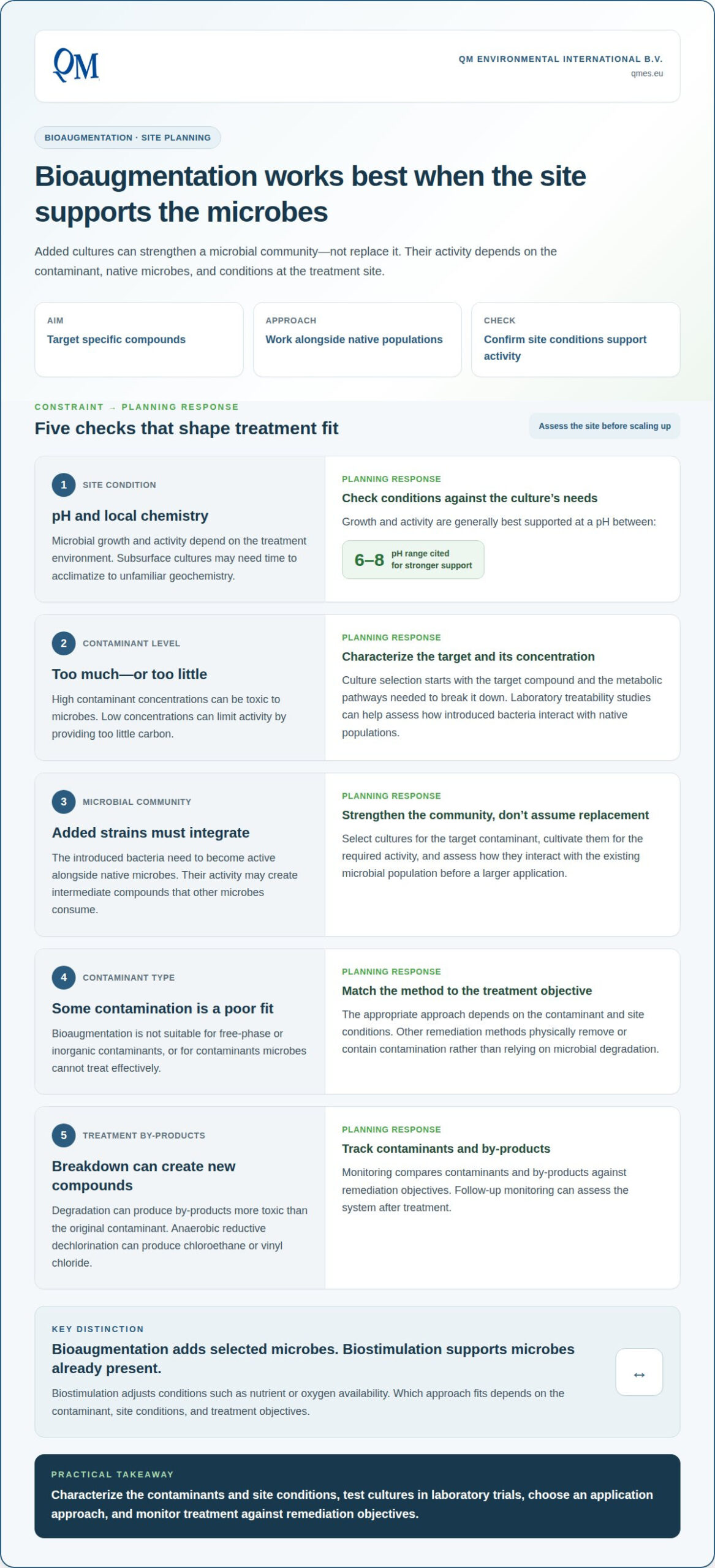
Selected microbial cultures are introduced into treatment environments such as wastewater bioreactors or contaminated groundwater. Selection starts with the target compound and the metabolic pathways needed to break it down. In a bioreactor, added strains may process compounds that native populations break down slowly. Their activity can also create intermediate compounds that other microbes consume. The aim is to strengthen the community, not take over the system. Bioaugmentation effectiveness depends on microbial activity, integration with native populations, and suitable site conditions.
Selection and cultivation prepare microbes for the conditions they’ll encounter. A culture is chosen for its affinity for a target contaminant, then cultivated under conditions that support the required activity. After introduction, bacteria need to acclimatize, particularly in subsurface environments with unfamiliar geochemistry. Growth and activity are generally best supported at a pH between 6 and 8. Carbon availability also matters: high contaminant concentrations can be toxic, while low concentrations can limit activity by providing too little carbon.
Bioaugmentation adds selected microorganisms; biostimulation instead encourages microbes already present by adjusting conditions such as nutrient or oxygen availability. Other remediation methods physically remove or contain contamination rather than relying on microbial degradation. The appropriate approach depends on the contaminant, site conditions, and treatment objectives. Laboratory treatability studies can assess how introduced bacteria interact with native populations before a larger application.
In the United States, regulators generally support bioaugmentation across jurisdictions, while oversight depends on the site and project. In Canada, injection of non-indigenous microorganisms into the environment is regulated under the Canadian Environmental Protection Act, 1999. According to that Act’s Domestic Substances List requirements, microorganisms must be registered on the list for consideration in bioaugmentation, and few cultures are approved for use. Regulatory requirements therefore differ by country and microorganism.
Synthetic biology offers another approach to microbial compatibility: researchers can design organisms with complementary metabolic roles. In a co-culture, one strain could transform a contaminant into an intermediate that another strain can use. Stabilizing that partnership means maintaining compatible growth needs and preventing one population from outcompeting the other. Any engineered culture intended for environmental treatment needs testing under relevant conditions. This differs from selecting naturally occurring bacteria and cultivating them for a target compound.
Bioaugmentation treatment duration depends on the contaminant, site conditions, and microbial activity. Applicable treatment-duration categories include 1 to 3 years, 3 to 5 years, and more than 5 years. Project cost is given after a quote request and depends on factors such as contaminated volume, delivery method, treatment duration, and monitoring needs.
Key limitations include conditions that inhibit microbial activity and contaminants that microbes cannot treat effectively. Bioaugmentation is not suitable for free-phase or inorganic contaminants, and degradation can produce by-products more toxic than the original contaminant. For example, anaerobic reductive dechlorination can produce chloroethane or vinyl chloride. Planning involves characterizing contaminants and site conditions, testing cultures in laboratory trials, and choosing an application approach. Monitoring tracks contaminants and by-products against remediation objectives; follow-up monitoring can assess the system after treatment.
Bioaugmentation in wastewater and contaminated-material treatment
In wastewater treatment, bioaugmentation adds selected microbial cultures to help degrade compounds that resist routine biological processing. The approach can target chlorinated compounds, petroleum hydrocarbons, and pathogens. It can also support treatment of residual or dissolved organic contamination in soil and groundwater. Microbes act on contaminants through metabolic pathways, transforming them into smaller compounds that other bacteria may also use. The treatment environment determines whether those reactions proceed under aerobic or anaerobic conditions.
A wastewater formulation must support the added bacteria as they enter the system. Microbes need a carbon source, nutrients, and suitable growth conditions. Formulations may supply nutrients, oxygen, or protection to help cultures survive and become active. Delivery also matters: liquid products, water-soluble packs, and dart briquettes can introduce microbes into lagoons. The appropriate format depends on the lagoon or process configuration and how the culture needs to be distributed.
Industrial wastewater presents distinct challenges. High-strength wastewater can combine elevated biological oxygen demand with toxic compounds, while persistent hydrocarbons, oils, and proteins may resist normal degradation. Selected bacterial cultures, including Bacillus, have been used in wastewater systems to address fats, oils, and grease, sludge, odors, chemical oxygen demand, biological oxygen demand, and suspended solids. Because these goals involve different treatment needs, characterize the contaminants carefully: a culture selected for organic compounds will not address every contaminant class.
For contaminated materials, bioaugmentation can treat residual and dissolved organic contaminants under aerobic or anaerobic conditions. Oxygen availability helps determine which microbial pathways can operate; anaerobic treatment relies on reactions that occur without oxygen. Some breakdown pathways create intermediate products, so monitoring should consider both the original contaminant and possible by-products. Free-phase and inorganic contaminants are not suitable bioaugmentation targets. For example, anaerobic reductive dechlorination can produce chloroethane or vinyl chloride, which may be more toxic than the original contaminant.
Emerging pollutants can also be addressed through immobilization-based treatment. In this setup, microbial cells attach to a carrier material instead of remaining freely suspended in water. The carrier can retain biomass in a treatment zone as contaminated water passes through, bringing microbes into contact with target compounds. Performance depends on whether the pollutant is accessible, the organisms remain active, and water flows through the treatment medium. A laboratory trial can test these interactions before field-scale application.
These mechanisms help engineers distinguish treatment targets from unsuitable ones and match microbial activity to process conditions. For an overview of how biological cultures are applied in wastewater systems, see wastewater treatment approaches.
Bioaugmentation in municipal and industrial wastewater
Municipal wastewater treatment relies on microbial communities that process organic matter as wastewater moves through treatment units. Bioaugmentation adds selected cultures when a targeted compound or process challenge requires additional microbial activity. The introduced population works within the existing treatment environment, so reactor conditions and wastewater composition shape its contribution. It does not replace the treatment system; the aim is to support biological breakdown when native activity alone may not address the target quickly enough.
Industrial applications are shaped by the material entering the lagoon or reactor. Paper-processing plant lagoons, for example, can receive organic waste such as lignin, cellulose, and pulping chemicals. Added microorganisms can support the breakdown of those compounds. Set the treatment objective according to the actual wastewater load, since a culture selected for one organic fraction may not address another. Process changes and variable influent composition can also affect the balance between added bacteria and the resident microbial population.
Reactor characteristics influence whether introduced microbes stay active and make useful contact with wastewater. Mixing and circulation affect how cultures spread through a treatment unit, while oxygen conditions determine whether aerobic pathways can operate. In lagoons, depth and sludge distribution can influence where biological activity occurs. A targeted application considers both the contaminant and the physical treatment system, rather than treating all municipal or industrial wastewater as one uniform mixture.
Bacillus is used in wastewater bioaugmentation because selected strains can contribute to the breakdown of organic loads. In industrial settings, this may be relevant to wastewater containing fats, oils, grease, proteins, or hydrocarbons. The specific strain and the contaminant matter: bacteria active against one compound aren’t automatically effective against another. Coaggregation, where bacterial cells attach to other cells, may help cultures associate with an existing population. In one study, Bacillus cereus G5 coaggregated with 90.5% of tested bacterial strains, while Bacillus megaterium T1 coaggregated with 76.2%.
Those coaggregation findings describe laboratory interactions, not proven treatment performance in a wastewater plant. Direct application of the reported Bacillus cereus G5 and Comamonas testosteroni A3 coaggregation to wastewater treatment had not been reported in the reviewed material. Engineers should distinguish cell-to-cell compatibility from contaminant degradation in an operating system. Treatability studies can test whether selected cultures address the target wastewater under relevant process conditions, including its contaminant mix and reactor environment.
Benefits and uses of bioaugmentation
Bioaugmentation can help wastewater systems address organic loads that challenge existing biological treatment. In sugar-processing lagoons, selected microorganisms can accelerate the breakdown of molasses, sugars, and other processing by-products. This application targets biodegradable material already present in the wastewater. Added cultures support microbial activity, while performance still depends on whether the lagoon provides conditions that sustain it.
Excess sludge is another reason operators consider bioaugmentation. Specialized strains for sludge reduction can reduce wastewater-treatment waste volumes by 20-40%. Lower sludge production can mean less material requiring hauling and disposal. The practical value depends on the system’s sludge generation and handling requirements, so volume reduction matters most where excessive sludge is a persistent operational burden.
Nutrient removal can also be a treatment target. Facilities facing tight nitrogen and phosphorus limits may consider bioaugmentation when conventional systems struggle to meet them. Added microorganisms can enhance biological processes, but they need conditions that support growth and activity. Nutrient balance, oxygen availability, and incoming wastewater characteristics all affect how the microbial population responds.
Bioaugmentation is also described as a wastewater treatment alternative that can reduce energy and chemical requirements, along with training needs. Lower energy demand and fewer applications can contribute to a reduced carbon footprint. These benefits are relevant where biological processes can meet the treatment objective without energy-intensive or chemical-dependent steps. Evaluate them against the plant’s actual operating demands rather than assuming they follow from using microbes alone.
The process does not require a secondary treatment step, reactor heating, or high pressure to achieve the desired results. Bioaugmentation can also produce little noise or other environmental disruption. For lagoon-based systems near communities, quieter operation and fewer offensive odors can matter alongside treatment performance. The operational effect depends on the site and application, including how cultures are introduced and whether the lagoon supports their activity.
These uses point to practical situations where biological treatment may help:
- Sludge management: Consider specialized strains where excessive sludge increases hauling and disposal demands.
- Organic wastewater loads: Sugar-processing byproducts such as molasses can be targets for microbial breakdown.
- Nutrient control: Bioaugmentation may support systems struggling with nitrogen or phosphorus limits.
- Operational demands: Reduced energy or chemical requirements may be relevant where those inputs are substantial.
Bioaugmentation works best as a targeted process choice, not a universal replacement for wastewater treatment. Matching microorganisms to the waste stream and treatment objective helps determine whether biological activity can address the operational problem and which outcomes the plant should monitor.
How bioaugmentation works in contaminated soil and groundwater
In contaminated soil and groundwater, bioaugmentation adds selected microorganisms to support pollutant breakdown. Targets often include residual or dissolved organic contaminants, such as hydrocarbons. Introduced microbes use metabolic pathways to transform contaminants, while native organisms may also process the resulting compounds. This is biological treatment, not physical removal: it aims to degrade contaminants in place. Performance depends on whether microbes reach the affected zone and remain active under local geochemical conditions.
Subsurface treatment begins with understanding where contamination is located and how groundwater moves. Soil layers vary in permeability, and fractures create uneven pathways. During injection, amendments may follow preferential flow paths, leaving other contaminated areas with less contact. Uniform distribution can therefore be difficult in heterogeneous or fractured ground. An injection design should account for the site structure, contaminant distribution, and groundwater movement, rather than assuming microbes will spread evenly.
After introduction, microorganisms need suitable conditions to acclimatize and multiply. Geochemistry can affect their ability to establish activity, particularly when introduced organisms come from a different environment. Adding nutrients or oxygen may enhance biodegradation if those inputs address a limiting condition. Oxygen supports aerobic microbial processes; anaerobic treatment relies on pathways that function without it. Optimization means matching amendments and microbial activity to the contaminant and subsurface conditions, not simply adding more material.
Contaminant concentration also affects microbial response. High concentrations can be toxic to microorganisms, while very low concentrations may provide too little carbon for active growth. Engineers need to consider both extremes when planning treatment zones. A concentrated source area may require a different biological approach from groundwater containing dilute dissolved contamination. The goal is to bring active microbes into contact with target compounds while avoiding conditions that suppress degradation.
Treatment timeframes vary with site conditions. In remote northern regions, treatment may take several years because cold temperatures can slow biodegradation, and microbial activity may occur mainly during summer. Seasonal changes in temperature and groundwater conditions can therefore influence when degradation progresses. Monitoring tracks contaminant concentrations and remediation objectives over time, including after groundwater conditions normalize. Follow-up measurements help determine whether treatment has met its objectives and applicable requirements.
Bioaugmentation does not fit every contamination problem. It is unsuitable for free-phase or inorganic contaminants, and microbial degradation can produce by-products that need attention. For example, anaerobic reductive dechlorination may produce chloroethane or vinyl chloride. The practical takeaway is to match treatment to contaminant form, soil structure, and site geochemistry. These factors determine whether microbes can reach the target, remain active, and degrade it effectively.
QM Environmental International B.V.
QM Environmental International B.V. offers microbial products and SBP technology for environmental management. Its portfolio includes MicroCat-SXMRF, MicroCat-XNL, MicroCat-XF, MicroCat-DNTRF, MicroCat-HX, and MicroCat-ANL. These products may be relevant when assessing whether microbial treatment fits a wastewater or contaminated-site challenge. The right approach depends on target contaminants, site conditions, and treatment objectives, so product selection should follow the project’s technical needs.
If you are evaluating bioaugmentation effectiveness for a wastewater, soil, or groundwater project, contact QM Environmental International B.V. to discuss the application.
Plan the next step for your site
For an engineering team, the next step is to connect the treatment objective with site-specific evidence. A treatability study or site assessment can help define the contaminants, environmental conditions, and performance measures that matter before choosing an approach. This groundwork gives teams a practical basis for evaluating bioaugmentation effectiveness within a wastewater or remediation project.
QM Environmental International B.V. offers MicroCat, SBP technology, and Dry Vapour Odor control as part of its treatment portfolio. The right option depends on the application and project needs. A focused technical discussion can clarify how these offerings relate to your treatment objectives.
Contact QM Environmental International B.V to discuss your project and its next steps. With a clear assessment of the site and treatment goals, your team can move forward with a more informed plan.
Frequently Asked Questions
What is Bioaugmentation?
Bioaugmentation is a bioremediation approach that adds selected microorganisms to support contaminant breakdown. In wastewater, soil, or groundwater, those microbes use biological processes to transform compounds they can metabolize. The term describes adding microbial capacity, not physically removing contaminated material. Whether it fits depends on the contaminant’s form and the treatment environment. For instance, dissolved organic contamination may be a candidate, while free-phase product is not.
What is bioaugmentation and how does it work?
Bioaugmentation introduces selected microorganisms that can act on specific contaminants. The microbes in QM products are naturally occurring, isolated from nature and cultivated, and combined with supporting ingredients. Enzymes help break down organic contaminants, which are converted to carbon dioxide and water. The introduced microbes consume contaminants and become part of the ecosystem rather than dominating it.
How effective is bioaugmentation for soil and groundwater cleanup?
Bioaugmentation can support soil and groundwater cleanup when target contaminants are accessible to active microorganisms and treatment conditions allow biodegradation. There is no single success rate that applies to every site. Assess project performance against its remediation objectives using contaminant trends and relevant groundwater measurements. A treatability study can help determine whether a selected culture acts on site materials before a field application is designed.
What contaminants can bioaugmentation treat effectively?
Bioaugmentation can target biodegradable organic contaminants, including petroleum hydrocarbons and some chlorinated compounds. In wastewater, microbial treatment may also address organic loads such as oils and proteins. It is not suitable for free-phase or inorganic contaminants, so the contaminant’s physical form matters as much as its chemical identity. Treatment assessment distinguishes dissolved or residual contamination from separate product that requires a different remediation approach.
What factors affect bioaugmentation success rates?
Bioaugmentation effectiveness depends on the match between microbes, contaminants, and site conditions. Temperature, geochemistry, available carbon, oxygen conditions, and contaminant concentration can all influence microbial activity. Soil heterogeneity also affects whether an amendment reaches the contaminated zone evenly. In cold northern settings, seasonal conditions can limit the period of active biodegradation. Laboratory treatability testing helps evaluate microbial response to site materials before designing field implementation and monitoring.
Disclaimer
Disclaimer
The information on this site is intended solely for personal, non-commercial use. Reproduction, modification, storage in an automated database, or publication of the contents of this site, or any part of its publications, in any form or for any purpose whatsoever, is prohibited without the written permission of QM Environmental International.
We have compiled the information on this site with the utmost care. However, some information may be outdated or incorrect. QM Environmental International accepts no liability for the consequences of actions or omissions based on the information provided.
We have taken all reasonable steps to keep this site free of computer viruses, but we cannot guarantee that it is completely virus-free. QM Environmental International is not liable for any damage to your computer equipment or software caused by viruses while visiting this site.
This site contains hyperlinks to other websites not designed or managed by QM Environmental International. QM Environmental International accepts no liability for the content and use of these sites.
If you have any questions about our privacy and cookie policy, please contact us at info@qmes.nl.
Last updated: June 24, 2025


