
MicroAktiv®-SH Supporting Water Quality and Shrimp Performance
Successful shrimp farming depends on the interaction between water quality, pond bottom conditions and nutrition. Uneaten feed, suspended organic matter and accumulating sludge can affect the growing environment, while efficient digestion and nutrient absorption are essential for healthy shrimp development. The MicroAktiv®-ALSH range addresses these connected needs through complementary microbial formulations for pond water, sediment and feed.
Developed for shrimp aquaculture, the range combines selected beneficial microorganisms with supporting ingredients tailored to each application. Together, the products are designed to help farmers maintain pond conditions that support shrimp health, survival and productive growth throughout the cultivation cycle.
MicroAktiv®-ALSH for pond water treatment
MicroAktiv®-ALSH focuses on improving the water in which shrimp grow. Its formulation contains multiple strains of Bacillus species, with a nominal microbial count exceeding 5 × 10⁹ colony-forming units per gram.
These beneficial microorganisms support the breakdown of suspended organic matter, excess feed and sludge. The formulation also contains flocculant aids and is intended to help stabilise the pond’s microbial biomass, including algae. According to the product sheet, the selected microorganisms help inhibit the growth of undesirable bacteria such as Vibrio species.
By supporting water quality and the pond’s biological balance, MicroAktiv®-ALSH is designed to create conditions favourable to shrimp survival, shell development and growth. For conventional use, the recommended application is approximately 500 grams per hectare per week until harvest. The powder is mixed with pond water in a bucket and distributed over the pond surface while aeration is operating.
MicroAktiv®-ALSH-S for pond bottom management
As the production cycle progresses, organic residues can accumulate on the pond bottom. This sediment can become a continuing source of water pollution and create conditions favourable to undesirable microorganisms.
MicroAktiv®-ALSH-S addresses this part of the pond environment. It combines selected Bacillus strains with natural seabed minerals and salts, with a nominal microbial count exceeding 10⁷ colony-forming units per gram.
The formulation is designed to support organic matter decomposition, reduce accumulated mud and help control ammonia levels. It also promotes the settling of suspended organic matter, helping improve water colour and transparency. Its mineral components supply nutrients intended to support the pond’s natural productivity.
The conventional application rate is approximately 5–10 kilograms per hectare per week until harvest. MicroAktiv®-ALSH-S is spread directly over the pond surface while aeration is operating.
MicroAktiv®-ALSH-G for feed supplementation
Water and sediment management are complemented by nutritional support. MicroAktiv®-ALSH-G, also described in the supplied GROW sheet, combines beneficial Bacillus strains with insoluble yeast cell walls rich in beta-glucans and mannans. Its nominal microbial count exceeds 5 × 10⁹ colony-forming units per gram.
The formulation is intended to support digestion, nutrient absorption and appetite, helping promote more uniform growth and improved feed conversion. Beta-glucans and mannans contribute to its intended support for immune function and intestinal health. The product sheet also describes an action aimed at limiting pathogen attachment to the intestinal tract, including Vibrio species.
For conventional use, MicroAktiv®-ALSH-G is added at 1–2 grams per kilogram of feed at every meal until harvest. Before application, it is mixed with potable water at a ratio of 1:20, then blended with the feed. The treated feed is left to dry for approximately ten minutes before feeding.
A coordinated approach to shrimp farming
The value of the MicroAktiv®-ALSH range lies in addressing different parts of the same production environment. MicroAktiv®-ALSH supports the water column, MicroAktiv®-ALSH-S targets pond bottom conditions, and MicroAktiv®-ALSH-G provides support through the feed. This coordinated approach is designed to reduce organic waste pressure while supporting shrimp nutrition and performance.
For the water and pond bottom treatments, the product sheets specify a dissolved oxygen concentration of at least 5 mg/L, a pH range of 7–8 and a temperature range of 15–40°C. Application programmes should be adapted to individual pond conditions with technical guidance.
Used within a well-managed farming programme, the MicroAktiv®-ALSH range offers shrimp producers a practical biological approach to improving the growing environment and supporting healthier, more productive shrimp.
Contact QM Environmental International B.V to discuss your environmental treatment needs. A clear objective is a strong starting point for a practical, evidence-led plan.
Frequently Asked Questions
What is MicroAktiv-ALSH?
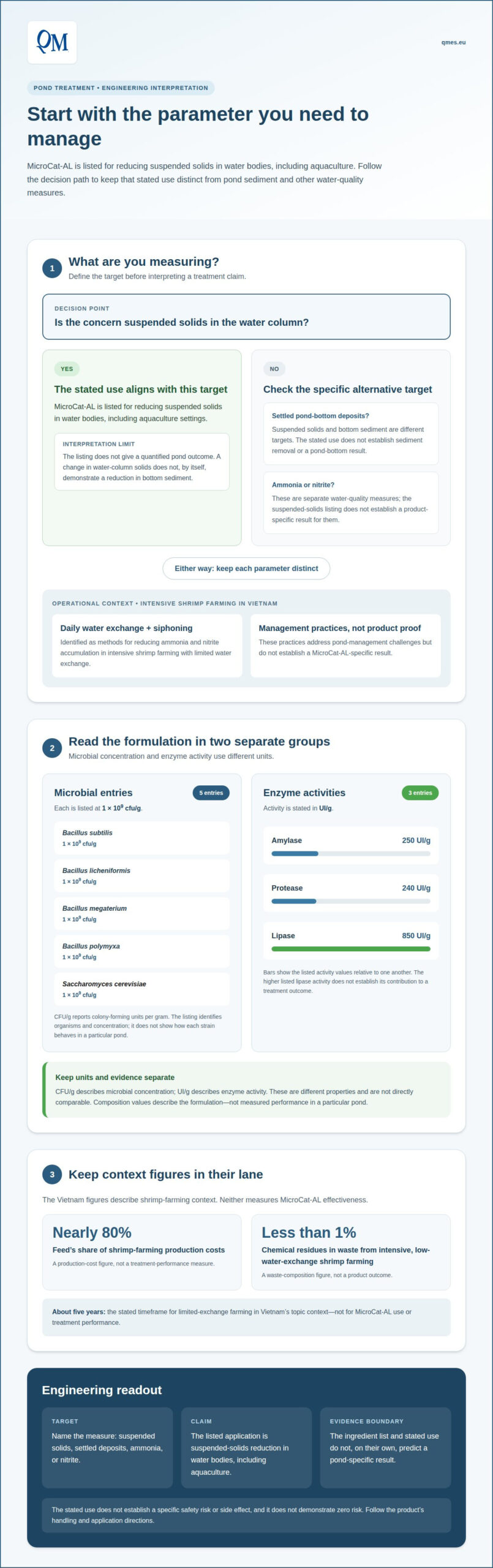
MicroAktiv-ALSH is a microbial product listed for aquaculture applications, including reducing suspended solids in water bodies. For a pond project, distinguish this stated use from sediment removal: suspended material in the water column and deposits settled on the pond floor are different treatment targets. Defining the target parameter helps engineers interpret the product’s stated application in the context of a specific water-management objective.
What are the technical specifications and features of MicroAktiv-ALSH?
The listed composition includes five microbial entries, each at 1 x 10exp+9 cfu/g: Bacillus subtilis, Bacillus licheniformis, Bacillus megaterium, Bacillus polymyxa, and Saccharomyces cerevisiae. It also lists amylase at 250 UI/g, protease at 240 UI/g, and lipase at 850 UI/g. CFU/g and UI/g report different properties, so compare each specification only with values using the same unit and measurement basis.
Disclaimer
Disclaimer
The information on this site is intended solely for personal, non-commercial use. Reproduction, modification, storage in an automated database, or publication of the contents of this site, or any part of its publications, in any form or for any purpose whatsoever, is prohibited without the written permission of QM Environmental International.
We have compiled the information on this site with the utmost care. However, some information may be outdated or incorrect. QM Environmental International accepts no liability for the consequences of actions or omissions based on the information provided.
We have taken all reasonable steps to keep this site free of computer viruses, but we cannot guarantee that it is completely virus-free. QM Environmental International is not liable for any damage to your computer equipment or software caused by viruses while visiting this site.
This site contains hyperlinks to other websites not designed or managed by QM Environmental International. QM Environmental International accepts no liability for the content and use of these sites.
If you have any questions about our privacy and cookie policy, please contact us at info@qmes.nl.
Last updated: June 24, 2025


