
Why do so many bench-scale successes fail to translate once they hit the field? You’ve likely experienced the frustration of inconsistent degradation rates or the mounting pressure of meeting the new EU Directive 2026/805 standards. It’s a common engineering hurdle where the biology seems sound in the lab, but site-specific variables create a bottleneck. Effectively navigating bioremediation challenges and solutions requires more than just adding nutrients; it demands a precise, pragmatic approach to microbial delivery and site assessment.
We know that your primary goal is achieving a measurable reduction in COD, BOD, and persistent organics like PFAS without the massive overhead of physical remediation. This guide explores how to overcome technical hurdles using advanced microbial consortia and site-specific engineering strategies. You’ll learn how to move from bench-scale testing to full-site implementation while keeping your cleanup timelines predictable and your results within strict regulatory limits. By focusing on the biological mechanisms that drive restoration, you can turn complex environmental liabilities into managed, successful projects.
Key Takeaways
- Learn why shifting from passive natural attenuation to a managed engineering process is essential for meeting 2026 regulatory compliance deadlines.
- Identify the core bioremediation challenges and solutions regarding bioavailability and fluctuating redox potentials that often hinder the degradation of persistent organic pollutants.
- Discover how to leverage specialized MicroCat formulations and biostimulation strategies to optimize microbial performance in diverse soil and groundwater matrices.
- Understand the role of professional Treatability Studies as a non-negotiable first step to account for site heterogeneity and ensure success when scaling from pilot to full-site implementation.
- Explore advanced remediation technologies, including SBP technology for encapsulated microbial delivery and QM-ZviER for combined abiotic-biotic treatment.
Understanding Bioremediation of Contaminated Sites: The Engineering Perspective
For an engineer, Bioremediation isn’t just a biological curiosity; it’s a calculated, managed process. We aren’t simply relying on passive natural attenuation and hoping for the best. Instead, we’re designing systems that accelerate metabolic pathways to meet strict cleanup targets. Navigating bioremediation challenges and solutions starts with treating the subsurface like a bioreactor where every variable, from nutrient delivery to oxygen levels, is under your control. This engineering perspective is the foundation for solving the most complex contamination issues in modern site cleanup.
At its core, this process relies on fundamental redox reactions. Microbes act as biological catalysts, using contaminants as energy sources through electron transfer. They strip electrons from organic pollutants, which act as the donors, and transfer them to electron acceptors like oxygen, nitrate, or sulfate. By understanding this stoichiometry, you can predict exactly how much substrate is needed to achieve your target reduction in COD or BOD. It’s a chemistry problem with a biological solution.
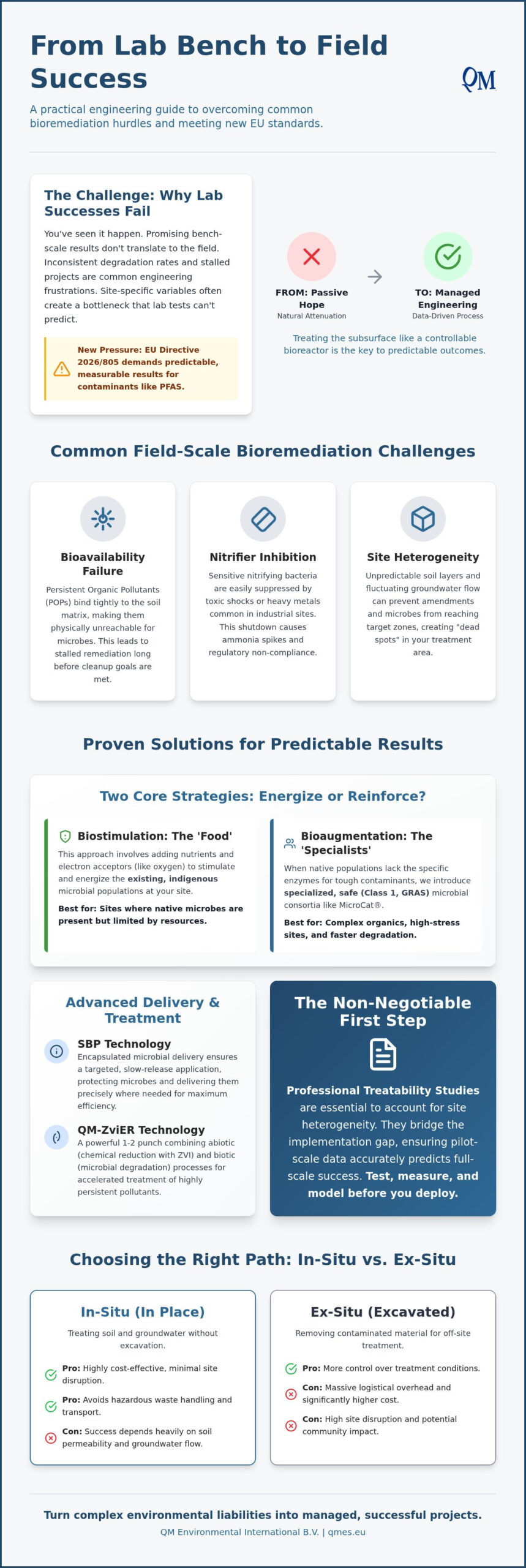
With the EU Directive 2026/805 now in effect, the pressure to hit these targets has intensified. Regulators are looking for predictable, measurable results, especially as they expand monitoring to include substances like PFAS and microplastics. Meeting these 2026 standards requires a shift from "hope-based" remediation to data-driven engineering that accounts for site-specific chemical resistance and microbial health.
In-Situ vs. Ex-Situ Bioremediation: Choosing the Right Path
Deciding whether to treat in place or excavate depends on site accessibility and the specific contaminant plume. In-situ methods are typically more cost-effective since they avoid the massive logistics of hazardous waste handling. However, their success hinges on groundwater flow and soil permeability. If the soil is too tight, your amendments won’t reach the target zones, which represents one of the primary bioremediation challenges and solutions engineers must balance during the planning phase. For deep design specs, engineers often refer to comprehensive design pillars that outline injection spacing and hydraulic conductivity requirements.
The Role of Microbial Consortia in Contaminant Degradation
Indigenous microbial populations often lack the specialized enzymes needed to break down complex, persistent organics, especially under the high-stress conditions found at contaminated sites. This is where bioaugmentation becomes critical. We use Class 1 microorganisms that are GRAS (Generally Recognized as Safe) certified to ensure environmental safety while maximizing degradation efficiency. We define microbial consortia as a synergistic group of bacteria that work together to target and break specific chemical bonds that a single strain couldn’t handle alone. These specialized strains are engineered to outperform indigenous populations by maintaining metabolic activity even when pH or redox potentials fluctuate.
Common Bioremediation Challenges in Modern Site Cleanup
Field-scale implementation often reveals complexities that aren’t visible during initial laboratory assessments. One of the most significant hurdles is bioavailability. For persistent organic pollutants (POPs), the contaminant molecules frequently bind tightly to the soil matrix or become sequestered in micropores where microbes simply can’t reach them. This physical separation leads to "stalled" remediation, a common scenario where degradation rates plummet before reaching cleanup goals. Addressing these bioremediation challenges and solutions requires a shift from simply adding microbes to managing the entire subsurface geochemistry.
In industrial settings, nitrifier inhibition presents another major obstacle. Nitrifying bacteria are highly sensitive to toxic shocks and heavy metal concentrations. When these populations are suppressed, ammonia levels spike, leading to regulatory non-compliance. Understanding the recent progress and challenges in bioremediation helps engineers recognize that metabolic "stalling" isn’t always about a lack of microbes; it’s often about environmental stressors that shut down existing biological pathways. This is particularly relevant in wastewater treatment scenarios where influent variability can disrupt the delicate microbial balance.
Nutrient and Electron Donor Limitations
Biological activity stops without the right stoichiometry. In many contaminated plumes, indigenous microbes consume available nitrogen and phosphorus quickly, creating "starvation" zones where degradation ceases. For anaerobic dechlorination projects, the limitation is often the electron donor. Without a consistent supply of fermentable organic carbon to produce hydrogen, the specialized bacteria required to strip chlorine atoms cannot function. Identifying these depleted zones early is vital for maintaining a steady cleanup timeline.
Geochemical Interference and pH Instability
The subsurface isn’t a neutral environment. High levels of dissolved iron or manganese can interfere with oxygen delivery systems by precipitating and clogging injection wells. pH stability is equally critical. For example, Dehalococcoides-based remediation requires a strictly controlled pH, as the process itself generates hydrochloric acid which can lower the pH and kill the very microbes doing the work. Using magnesium-based alkaline buffering agents to maintain a stable environment is a standard engineering fix for this issue. To ensure your site-specific variables are fully accounted for, conducting professional Treatability Studies is the most reliable way to prevent field-scale surprises.
Proven Bioremediation Solutions: Biostimulation and Bioaugmentation
Navigating bioremediation challenges and solutions often requires a two-pronged approach. You can either optimize the existing environment to help indigenous microbes thrive, known as biostimulation, or introduce specialized microbial strains to handle specific contaminants, known as bioaugmentation. The most effective projects often use a combination of both. To determine the right path, we rely on Site Assessment and Remediation Planning as the primary decision engine. This process evaluates the native microbial census and geochemistry to ensure your chosen strategy aligns with the site’s unique characteristics.
Choosing between these methods depends on the urgency of the cleanup and the complexity of the pollutants. If a site has a healthy but dormant population of degraders, biostimulation might suffice. However, if you’re dealing with recalcitrant compounds or tight regulatory deadlines, bioaugmentation provides the necessary metabolic boost. This strategic selection ensures that resources are allocated where they will have the most significant impact on contaminant reduction.
Strategic Biostimulation with EOS® Substrates
For long-term anaerobic projects, substrate transport is a common bottleneck. EOS PRO, an emulsified vegetable oil, is designed for high-performance transport through the soil matrix; it provides a slow-release carbon source that can sustain microbial activity for years. In contrast, EOS QR is formulated for rapid anaerobic conversion, making it ideal for treating high-concentration "hot spot" areas that require immediate intervention. We often enhance these substrates with nutrient infusions and vitamin B12. These additives act as essential cofactors that speed up the kinetics of reductive dechlorination, helping you hit your targets faster.
Precision Bioaugmentation with MicroCat® Products
When the indigenous population can’t keep up, bioaugmentation with MicroCat formulations fills the gap. In bioremediation projects on contaminated sites, MicroCat-XBS and our BAC9 formulation are proven products to quickly establish a microbial population capable to biodegrade Petroleum and Chlorinated hydrocarbons. These products represent 40 years of research, offering a level of reliability that generic supplements simply can’t match.
Bridging the Implementation Gap: From Pilot to Full-Scale
Taking the leap from a controlled laboratory environment to a complex field site is where the most significant bioremediation challenges and solutions are truly tested. While bench-scale success proves biological potential, the field introduces variables like soil heterogeneity, often described as the "Swiss cheese" effect. Contaminants don’t distribute evenly; they follow preferential flow paths, which can leave some areas saturated and others completely untouched by your amendments. Without a precise engineering plan that accounts for these delivery logistics, you risk treating the wrong zones entirely. Navigating these bioremediation challenges and solutions requires moving beyond laboratory theory into the practicalities of site-specific implementation.
Effective full-scale implementation also demands a robust delivery infrastructure. Designing injection well networks requires a deep understanding of hydraulic conductivity to ensure that amendments reach the plume’s core. Monitoring frequency should be high during the initial phase to capture the system’s response to the first injections, allowing for real-time adjustments. By focusing on Site Assessment and Remediation Planning, engineers can reduce the uncertainty that often plagues large-scale projects.
The Value of Professional Treatability Studies
We consider professional Treatability Studies a non-negotiable first step for any serious engineering project. These studies allow us to identify the optimal biological solutions in a controlled environment before you commit to field deployment. By testing site-specific soil and groundwater in the ISO 9001:2015 certified laboratory at QM Environmental International B.V., we can determine exact dosing requirements. This prevents the costly mistakes of "over-dosing" additives, which wastes budget, or "under-dosing," which leads to failed cleanup targets. You’re not just buying a product; you’re verifying a result before the first well is even drilled.
Monitoring and Adaptive Management
Success in the field requires looking beyond just contaminant concentrations. You need to track key performance indicators (KPIs) like dissolved oxygen, redox potential, and pH to ensure the subsurface environment remains hospitable for microbial growth. Modern molecular tools allow us to monitor microbial population health in real-time. For example, tracking BAC-9 levels helps confirm that your added consortia are actually colonizing the subsurface and performing as expected. This data allows for adaptive management, where you can adjust dosing strategies based on actual field performance rather than static projections. If you want to move from uncertainty to predictable results, start with professional Treatability Studies and Remediation Planning to secure your project’s success.
Advanced Technologies in Bioremediation for 2026
As we look toward the regulatory landscape of 2026, the most effective bioremediation challenges and solutions involve hybrid systems that bridge the gap between chemistry and biology. We’re moving beyond simple nutrient addition toward integrated platforms that combine abiotic and biotic processes. This evolution is necessary to meet the tighter standards of the EU Water Framework Directive and the EPA’s 2026 risk management agendas. By deploying technologies like QM-ZviER engineers can achieve predictable results even in the most difficult site conditions. At QM Environmental International B.V., we focus on producing results, not just selling product, ensuring every technical intervention is backed by data and field performance.
In-Situ Chemical Reduction (ISCR) with EOS ZVI
Chlorinated solvent plumes often require a more aggressive start than biology alone can provide. In-Situ Chemical Reduction (ISCR) uses zero-valent iron (ZVI) to provide an immediate drop in oxidation-reduction potential (ORP). When you combine the rapid electron-donating power of micron-scale ZVI with the long-term metabolic support of EOS biological substrates, you create a synergistic environment. The ZVI handles the initial high-concentration shock, while the biological component sustains the reductive dechlorination process over several years. The micron-scale particles in EOS ZVI are particularly effective because they penetrate the soil matrix more deeply than standard iron filings, reaching the contaminants sequestered in lower-permeability zones.
Future-Proofing Your Site Remediation Strategy
Meeting the strict 2026 regulatory targets requires shifting from passive observation to active engineering. Successfully navigating bioremediation challenges and solutions involves more than just selecting a microbial product; it requires integrating precision biostimulation with targeted bioaugmentation. By prioritizing Treatability Studies, you can eliminate the guesswork that often leads to stalled projects and inconsistent field results. This data-driven approach ensures that every injection serves a specific metabolic purpose and moves the site closer to closure.
With over 40 years of MicroCat research and development and ISO 9001 and 14001 certified production facilities, QM Environmental International B.V. provides the scientific reliability your projects demand. Our global technical support team is ready to help you implement advanced technologies like ISCR and encapsulated delivery to keep your cleanup timelines predictable. If you’re ready to move from pilot-scale uncertainty to measurable, full-scale success, Consult with QM Environmental International B.V. experts for a professional Site Assessment. You’ve got the engineering expertise; we’ve got the biological tools to help you finish the job.
Frequently Asked Questions
What are the main limitations of bioremediation for contaminated sites?
The primary limitations involve the physical bioavailability of contaminants and the metabolic constraints of indigenous microbes. In many cases, pollutants are sequestered in soil micropores where bacteria can’t physically reach them. Additionally, extreme pH levels or high concentrations of toxic heavy metals can inhibit microbial activity. These factors often represent the most difficult bioremediation challenges and solutions, requiring specific engineering interventions to overcome physical and chemical barriers.
How do you choose between biostimulation and bioaugmentation?
Choosing the right method depends on the health of your native microbial population and the project’s urgency. If a site already contains the necessary degraders but they’re inactive due to nutrient lack, biostimulation is usually sufficient. However, if the contaminants are highly specialized or the cleanup timeline is tight, bioaugmentation provides a faster metabolic boost. We use proven, Class 1 certified microbial consortia to ensure predictable results when native populations aren’t enough.
Can bioremediation handle heavy metal contamination?
Microbes can’t destroy heavy metals, but they can change their oxidation state to make them less mobile or toxic. This process, known as biotransformation, involves bacteria precipitating metals like chromium or uranium into insoluble forms. While this doesn’t remove the metal from the soil matrix, it effectively prevents it from leaching into groundwater. This strategy is often a vital part of a broader site assessment and remediation planning effort for mixed-waste sites.
How long does a typical bioremediation project take to reach targets?
Cleanup timelines vary based on site geochemistry and contaminant mass, but most in-situ projects range from six months to three years. Factors like soil permeability and the initial concentration of pollutants dictate the pace. By using advanced substrates like EOS PRO for long-term delivery or bioaugmentation for rapid hot spot treatment, engineers can often compress these timelines. This helps meet strict regulatory deadlines more reliably than with passive natural attenuation.
What is the role of zero-valent iron (ZVI) in biological remediation?
Zero-valent iron acts as a powerful abiotic reducing agent that provides an immediate drop in oxidation-reduction potential. In combined abiotic-biotic remediation, ZVI handles the initial chemical reduction of chlorinated solvents, creating a hospitable environment for anaerobic microbes to finish the job. This synergy allows for a much faster reduction in contaminant mass compared to using biological methods alone, especially in high-concentration source zones where microbes might otherwise struggle.
Are bioaugmentation microbes safe for the surrounding environment?
Yes, the microbial strains used in bioaugmentation are Class 1/GRAS certified and non-pathogenic. These bacteria are naturally occurring and have been selected for their specific ability to degrade industrial pollutants without harming local ecosystems. Because they’re specialized for certain contaminants, their populations typically decline naturally once the food source is depleted. This ensures no long-term disruption to the site’s indigenous ecology while providing a highly effective cleanup solution.
Why do bioremediation projects often stall after an initial success?
Projects usually stall due to nutrient depletion, pH shifts, or the "Swiss cheese" effect of soil heterogeneity. As microbes consume contaminants, they also exhaust available nitrogen, phosphorus, and electron donors. Without ongoing monitoring and adaptive management, the subsurface environment can become too acidic or nutrient-poor to sustain degradation. This highlights why understanding bioremediation challenges and solutions requires a focus on maintaining stable geochemical conditions throughout the entire project lifecycle.
How much does a professional Treatability Study cost for an industrial site?
We provide competitive pricing for professional Treatability Studies based on the complexity of the contaminants and the number of remedial options being tested. These studies are essential for identifying the most cost-effective biological solution before committing to a full-scale field deployment. By testing site-specific soil and groundwater in our ISO 9001:2015 certified laboratory, we help you avoid the high costs associated with over-dosing additives or project failure.
Disclaimer
Disclaimer
The information on this site is intended solely for personal, non-commercial use. Reproduction, modification, storage in an automated database, or publication of the contents of this site, or any part of its publications, in any form or for any purpose whatsoever, is prohibited without the written permission of QM Environmental International.
We have compiled the information on this site with the utmost care. However, some information may be outdated or incorrect. QM Environmental International accepts no liability for the consequences of actions or omissions based on the information provided.
We have taken all reasonable steps to keep this site free of computer viruses, but we cannot guarantee that it is completely virus-free. QM Environmental International is not liable for any damage to your computer equipment or software caused by viruses while visiting this site.
This site contains hyperlinks to other websites not designed or managed by QM Environmental International. QM Environmental International accepts no liability for the content and use of these sites.
If you have any questions about our privacy and cookie policy, please contact us at info@qmes.nl.
Last updated: June 24, 2025