

Frequently asked questions about bioremediation with QM products
Bioremediation is a cost-effective, sustainable and natural approach to cleaning contaminated soil and groundwater by using biological agents such as bacteria, microbes, fungi and other organisms or their enzymes.
The process of bioremediation requires two major components:
1) An Electron Donor
2) An Electron Acceptor
Contaminants can serve as both electron donors and electron acceptors. For example, a petroleum-based hydrocarbon can be a useful carbon source, electron donor, for certain bacteria, and a chlorinated solvent such as tetrachloroethene (PCE) can be used as an electron acceptor by another bacterial strain. A crucial insight into the success of a bioremediation project is determining the role of the contaminant at the site and what key component is needed to promote bioactivity. Below are two tables with some common examples of electron donors and acceptors.
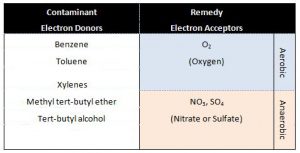
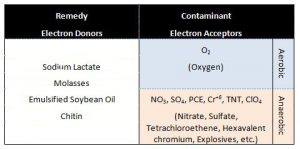
If the right components are available at a contaminated site, bioremediation can occur naturally without human intervention. This is known in the industry as monitored natural degradation (MNA) because all components necessary for cell growth and reproduction are present and bioremediation occurs without external stimulation.
When an electron donor or acceptor is missing, biostimulation is often an option to supplement the missing component. And when the microorganisms that carry out these reactions are not present, bioaugmentation can continue the reaction and facilitate bioremediation.
Biostimulation: The addition of nutritional supplements to increase microbial metabolism and promote biodegradation. An electron donor or acceptor may need to be added or macro- and micronutrients may be required for optimal biomass development.
Bioaugmentation: The addition of beneficial microorganisms to improve the rate or extent of biodegradation (e.g., native microbes are not present or present in low amounts, so organisms are added).
Most project managers give two reasons for choosing a particular remediation technology:
Price and Performance
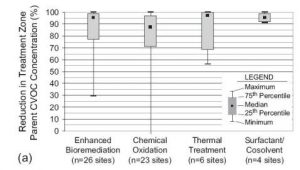
In most project situations, bioremediation meets or exceeds both criteria (price and performance) compared to other remediation technologies. At QM Environmental International, we also offer project support from planning to completion at no additional cost.
Price (US remediation costs)
Enhanced bioremediation $ 29/m³
Thermal treatment $ 88/m³
Chemical oxidation $ 125/m³
Rinsing with surfactants and co-solvents $ 385/m³
Source:
McDade et al. Remediation Journal 15, 9-18, 2005.
McGuire et al. Ground Water Monitoring and Remediation 26, 73-84, 2006.
EAS® stands for quality; it is REDOX Tech’s trademark, derived from “Electron Acceptor Solution” and from “Effective Anaerobic Solution.”
EAS® is not recommended for sites where there is significant free petroleum product (i.e. slightly non-aquatic phase liquid = LNAPL). However, EAS® can be applied to sites with residual contamination (such as an oily sheen or high dissolved concentrations) and can be used as post-treatment after free product is removed. Residual contamination in the unsaturated zone (vadose zone) of the soil may need to be addressed with other techniques.
- Groundwater must be deeper than 1.5 m below the ground surface.
- The distance from residences, surface water or a private well must be greater than 30 m.
- Distance to municipal drinking water well (100 gpm) > 380 m.
- The plume should be stable or decreasing.
EOS® (Emulsified Oil Substrate) is a specially developed organic compound designed specifically for bioremediation of soil and groundwater. Its composition and production have been carefully developed to allow effective diffusion into the saturated zone and to provide a long-term source of hydrogen used by microorganisms to reductively degrade certain contaminants (such as tetrachloroethylene and trichloroethylene, or PER & TRI, and their degradation products).
Common products that attempt to mimic our technology are referred to as emulsified vegetable oils or EVO (Emulsified Vegetable Oils).
Unlike generic EVO products, our patented EOS® technology is formulated so that the oil droplets are very small (~1 micron) and have a slight negative charge. This prevents the droplets from clumping together while promoting adsorption onto slightly positively charged aquifer materials. Our emulsion is designed to move through subsurface pores and adhere to sediment, providing a hydrogen source that remains available for many years.
Simply put, anaerobic bacteria, which are required for reductive dechlorination (the biological process by which PER & TRI are converted to the non-toxic ethylene), need a food source. EOS® provides both rapidly available carbon (soluble substrate) and slowly released carbon (soybean oil), along with the necessary nutrients to stimulate biological activity. In the presence of these nutrients, anaerobic bacteria “breathe” the chlorinated solvents, resulting in harmless degradation products and energy for growth. Its effective dispersal allows EOS® to be applied under a variety of soil and site conditions.
Unlike locally prepared emulsions and pure soybean oil, EOS® does not float on the groundwater level. EOS® is designed to prevent clumping or flocculation of the small oil droplets. This promotes dispersion of the emulsion during injection over the intended distance into the subsurface, while adsorbing the substrate to the sediment surfaces along the way.
After the injection process is complete, EOS® adheres very quickly to the sediments in the aquifer, preventing the mobilization of contaminants. Indeed, some chlorinated solvents may adhere to the substrate, further reducing the likelihood of mobilization.
EOS® is designed so that the droplet sizes are significantly smaller than those of most pores in the aquifer. The slightly negative charges on the droplets repel the droplets from each other as they are absorbed by the slightly positively charged ground layers.
The metabolic degradation of soybean oil in the aquifer (e.g., fermentation to hydrogen and acetate) is the crucial first step to promote reductive dechlorination. However, without emulsification, soybean oil would degrade so slowly that it would not effectively stimulate biodegradation processes. Soybean oil combines the desired biodegradability with a long duration of action, allowing EOS® to remain effective in the aquifer for at least three to five years.
Treatment with EOS® can lead to temporary adsorption of contaminants in the oil phase, which is a clearly beneficial effect. Although biodegradation does not occur in the oil phase, this adsorption can slow the migration of contaminants – particularly DNAPL. Years of laboratory and field research have shown that contaminants are released over time from the adsorbed phase to the aqueous phase as biodegradation in the aqueous phase progresses. The overall effect is that the contaminants remain within the treated area, reducing the likelihood of spreading beyond the treatment zone.
Extensive laboratory and field studies have shown that EOS® can support anaerobic biodegradation for three to five years, depending on the amount of substrate injected and local conditions. In a laboratory column study, Long and Borden (2005) showed that a single injection of emulsified soybean oil can support complete reductive dechlorination of 10,000 µg/L PCE to ethylene for up to seven years. Field tests of emulsified oil technology by the U.S. Air Force Center for Environmental Excellence (AFCEE) have shown that emulsified edible oils lasted more than three and a half years at Dover Air Force Base (AFB), more than three years at Edwards AFB and more than two and a half years at Altus AFB. A recent biobarrier project supported by the Environmental Security Technology Certification Program demonstrated that a single EOS injection lasted more than a year and a half while reducing inflow perchlorate concentrations below the detection limit (more than 99.9% reduction) with simultaneous reduction of 1,1,1-TCA to non-toxic end products (Zawtocki et al., 2004). Monitoring continues to evaluate the effective lifetime of this barrier.
Based on bench scale and field studies, proper application of EOS® should remain effective in the aquifer for at least three to five years. As part of the engineering design requirements, you have control over the life expectancy of the remediation. Your QM representative can help you design an adequate substrate life expectancy for your project.
Absolute. For source control applications, EOS® is usually injected into a grid or a series of closely spaced barriers. Depending on proximity to yard boundaries, a recirculation system may be considered.
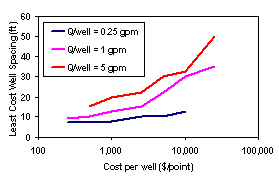
Field tests have shown that EOS® can be spread over long distances in the subsurface from just a few injection points. However, drilling costs are only a portion of the total project cost. Using greater injection point spacing can increase overall costs by increasing injection time (i.e., labor costs).
The graph below illustrates the effect of drilling costs and injection well flow rates on the cheapest well spacing. When injection and drilling costs are low, it is actually cheaper to use wells with small spacing. However, as drilling costs and/or achievable injection and flow rates increase, larger well spacing becomes more cost-effective. For large projects, it is useful to make cost estimates for different well spacing to find the least expensive alternative. A site-specific analysis should consider available water supply, access constraints, continuous versus intermittent injection, labor and drilling costs, etc.
EOS® is a low-viscosity fluid and requires no specialized handling or pumping equipment. It is designed to migrate at ambient temperature and low pressure into the aquifer away from the injection point. The ability to introduce the material into the aquifer at a significant distance from the injection point is a key advantage of EOS®.
EOS® is supplied as a concentrate in 200 L drums or 1000 L IBCs or in bulk and must be diluted prior to injection at a ratio of at least four parts water to one part EOS®. Depending on your specific design, a “water chase” or an initial dilution ratio of 10:1 may be used for injection purposes. Both methods are equally effective and each has its advantages. The most important consideration is to deliver the proper amount of EOS® throughout the treatment area.
One advantage of using EOS® at your site is that you can use the injection methods of your choice. Our experience has shown that where direct push technology can be used, installation of micro wells (¾ to 1 inch PVC wells) can be a very cost-effective option. However, microwells are no better or worse than conventionally installed wells. When multiple technologies are appropriate, cost factors normally determine the choice of conveyance.
There are several injection techniques, including simultaneous injection of multiple wells, to reduce injection costs. EOS® can be diluted in a storage tank and then injected, or can be injected using a Dosatron. The Dosatron eliminates tank mixing and reduces injection labor costs. Your QM representative can advise you on suitable injection methods.
EOS® is designed to be easily dosed throughout the groundwater treatment zone. We have found that using rinse water reduces labor costs. Increasing the dilution ratio of the concentrate has the same effect as rinsing. Instead of diluting the concentrate 4:1 with water and doing a rinse, you can simply increase the dilution and omit the rinse. With post-rinse, the system can be automated to deliver potable water into the subsurface. A low-pressure delivery of potable water does not require on-site monitoring; however, an injected diluted emulsion must be monitored. Both methods meet the design requirements.
There are numerous sites where recirculation has been used during injection of EOS®. Recirculation during injection offers the advantages of using available water resources on site to generate groundwater flow gradients to pull EOS® through the aquifer.
Yes. EOS® is a natural substrate of nutritional quality and can be produced with vegetable oil that does not contain GMO.
To date, our remediation products have been used in the following U.S. states:
AL, AR, AZ, CT, CA, CO, DE, FL, GA, IN, IL, KY, LA, MA, MD, ME, MI, MN, MO, MT, NE, NC, NH, NJ, NM, NV, NY, OH, OK, OR, PA, PR, SC, TN, TX, UT, VA, WA, WI, WY
In addition, EOS is used in countries such as:
Australia, Austria, Belgium, Brazil, Canada, Denmark, France, Germany, Hungary, Italy, Japan, Netherlands, New Zealand, South Africa, Spain, Sweden, Taiwan, UK
We found that EOS® does not migrate a significant distance from the injection point. Once the injection process stops, the driving force ceases and EOS®, by design, absorbs to the aquifer materials and does not continue to migrate with the groundwater. Downstream monitoring using visual indicators (such as breakthrough in downstream performance monitoring wells) or an increase in total organic carbon (TOC) can be used to evaluate how far EOS® has moved through the aquifer. Recirculation is another way to provide hydraulic control during injection or to move EOS® in a certain direction or over a certain distance in the subsurface.
Your monitoring program may be specified for your site by the regulatory agency with jurisdiction over the site. At a minimum, your monitoring program should include the relevant pollutants and reduction-oxidation (REDOX) potential. Field parameters such as pH, conductivity and dissolved oxygen are also recommended.
A more detailed monitoring program could include inorganic compounds (e.g., nitrate and sulfate), metals (e.g., iron and manganese), total organic carbon, light hydrocarbon gases (methane, ethane, ethylene) and possibly volatile fatty acids. Increasingly complex sites could also monitor for phospholipid fatty acids and various molecular biological tools, including population counts for Dehalococcoides ssp., other dehalogenating microorganisms and functional genes.
There are both direct and indirect ways to measure the presence of EOS® in the aquifer. Apparent turbidity, observed as a faint white tinge in performance monitoring wells, can sometimes be used as a visual indicator of the presence of EOS®. Laboratory analysis for total organic carbon (TOC) and volatile fatty acids (VFA) can also provide direct indications of substrate presence. Indirectly, changes in groundwater geochemistry due to the formation of anaerobic reducing conditions suggest that EOS® is present.
Yes, immobilization of metals is possible. Because EOS® creates reducing conditions in the aquifer, certain redox-sensitive metals (such as aluminum, copper, lead, manganese and zinc) may precipitate into non-mobile forms of various metal sulfides. If your site does not have sufficient sulfate concentration, the addition of EAS may be necessary. Contact us for more information and to discuss your site details.


