
Most grease abatement strategies don’t actually eliminate lipids; they just push an operational crisis further down the pipe. When treatment plants rely solely on mechanical skimming or basic surfactant dosing, emulsified organics slip through untreated. Achieving true industrial fat oil grease reduction requires permanent biochemical degradation at the source rather than simply shifting stubborn waste into downstream municipal infrastructure.
If you manage an industrial facility, you’re familiar with the headaches that follow heavy lipid loads. Escalating municipal surcharges for BOD and COD, recurring lift station blockages, and lipid-driven filamentous bulking in secondary clarifiers drain operational budgets and consume valuable maintenance hours. Pumping out interceptors offers temporary relief, but it never solves the underlying biological imbalance.
This engineer’s guide explains how to design and run a targeted biological FOG reduction program that eliminates compliance surcharges, prevents clogs, and restores secondary process stability. We’ll examine the enzymatic hydrolysis and microbial pathways required for complete cellular conversion, compare dosing strategies, and detail how to optimize your treatment system for long-term reliability.
Key Takeaways
- Understand how unmanaged lipids compromise aeration basin oxygen transfer efficiency and drive filamentous bulking in secondary clarifiers.
- Discover why lasting industrial fat oil grease reduction demands complete microbial beta-oxidation rather than superficial treatments that merely displace waste.
- Unpack the “emulsification trap” of chemical surfactants and enzyme-only dosing that push saponification risks and compliance surcharges downstream.
- Learn why systematic waste stream characterization and treatability studies are essential prerequisites before introducing bioaugmentation cultures.
- Explore how purpose-formulated bacterial consortia like MicroCat-SXMRF/DNTRF and MicroCat-GEL stabilize biological processes and cut recurring line maintenance costs.
The Real Cost of Industrial FOG: Why Mechanical Solutions Aren’t Enough
Most commercial kitchen literature treats grease as an interceptor-cleaning chore. In heavy manufacturing, food processing, and chemical refining, however, the stakes run much higher. Heavy lipid loading fundamentally disrupts downstream physical and biological unit operations long before wastewater reaches a municipal collection point. Relying solely on physical separation overlooks how dissolved, colloidal, and emulsified fats interact with secondary treatment systems.
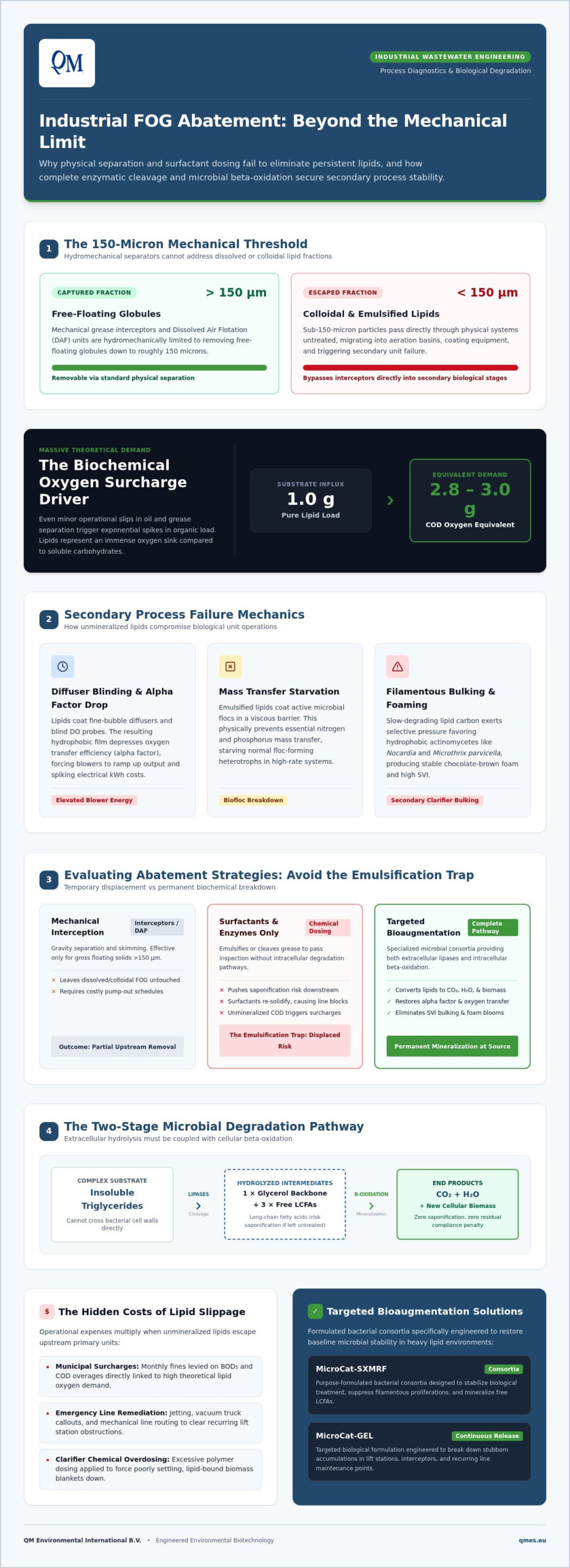
Standard mechanical grease interceptors and dissolved air flotation (DAF) units are hydromechanically engineered to pull out free-floating globules down to about 150 microns. Anything smaller passes straight into downstream processes. When these escaped lipids enter aeration basins, they coat fine-bubble diffusers, blind dissolved oxygen (DO) probes, and form hydrophobic barriers around air bubbles. This physical film drops your oxygen transfer efficiency (alpha factor), forcing blowers to ramp up output just to keep DO levels above critical thresholds. The result is spiraling energy consumption that skimmers can’t prevent.
Operational Risks: From Pipe Blockages to Filamentous Growth
Once inside the bioreactor, emulsified lipids coat active microbial flocs. This viscous layer physically restricts mass transfer, preventing essential nitrogen and phosphorus from reaching aerobic bacteria. When floc-forming heterotrophs starve, specialized actinomycetes take over. Excessive grease loads reliably trigger widespread proliferations of slow-growing, hydrophobic bacteria such as Nocardia and Microthrix parvicella, generating viscous, stable chocolate-brown foam across aeration basins and secondary clarifiers.
By providing an abundant, slow-degrading carbon substrate that normal floc-formers cannot readily metabolize under high-rate conditions, high FOG concentrations act as a continuous selective pressure that favors slow-growing filamentous organisms over beneficial bioflocs. This dynamic leads to severe sludge bulking, high sludge volume index (SVI) values, poor blanket settling, and inevitable solids carryover in the final effluent.
Compliance and Surcharges: The Economic Driver for Reduction
Fats and oils carry an immense theoretical oxygen demand: breaking down a single gram of pure lipid requires roughly 2.8 to 3.0 grams of chemical oxygen demand equivalent. Consequently, even modest slips in oil and grease separation trigger massive spikes in total COD and BOD5 concentrations. Municipal utility authorities strictly penalize these exceedances through tiered volumetric surcharges and local limit enforcement.
Analyzing the true return on investment for rigorous industrial fat oil grease reduction means factoring in these hidden costs:
- Municipal surcharges: Monthly penalties levied on biological and chemical oxygen demand overages caused by unmineralized lipids.
- Emergency line remediation: Unscheduled jetting, vacuum truck callouts, and mechanical line routing to clear downstream fat accumulations.
- Energy and chemical penalties: Elevated blower kilowatt consumption and excessive polymer usage applied in clarifiers to force poorly settling, lipid-bound biomass to drop.
Investing in source-level biological management stabilizes your plant chemistry. Combining proper operational controls with targeted industrial wastewater treatment solutions turns persistent compliance risks into reliable, day-to-day baseline stability.
The Science of Lipid Bio-degradation: Enzymes vs. Microbes
True biological degradation isn’t just liquefying grease so it flows out of sight. In wastewater engineering, bio-degradation is the complete microbial conversion of complex lipids into carbon dioxide, water, and new cellular biomass. Achieving that full conversion in high-load industrial systems requires two distinct biological events: extracellular cleavage and intracellular mineralization.
Lipids enter your system primarily as insoluble triglycerides. Because these large molecules cannot pass through bacterial cell walls, the treatment biomass must first release extracellular lipases. These enzymes break the ester bonds holding the triglyceride together, yielding one glycerol backbone and three free long-chain fatty acids (LCFAs). Rather than adding external chemical surfactants that disrupt clarifiers, high-performing bacteria generate their own biosurfactants. These surface-active compounds lower interfacial tension, dispersing grease into micro-droplets that maximize contact area for enzymatic attack.
Lipolysis: The First Step in Biological FOG Reduction
Lipase adsorption onto the oil-water interface controls the initial breakdown speed. Process conditions dictate this reaction rate: industrial lipases generally perform best within a pH range of 6.5 to 8.5 and require temperatures above 15°C to maintain sufficient kinetic activity. In standard activated sludge systems, the enzymatic cleavage of triglycerides into free fatty acids represents the rate-limiting hydrolysis bottleneck that causes undegraded grease to pass into secondary treatment units.
If your system stalls at this initial stage, unhydrolyzed fats slip through to collection points, running afoul of municipal discharge limits enforced under National Pretreatment Program regulations.
Microbial Specialization: Why Generic Cultures Often Fail
Enzymes alone cannot complete the job. Once lipolysis generates free LCFAs like palmitic, stearic, and oleic acids, these compounds become acutely toxic to generic activated sludge bacteria if left to accumulate. LCFAs adsorb onto cell membranes, disrupting nutrient transport and cell permeability.
This is where standard indigenous bacteria fall short, and specialized bioaugmentation strains make the difference:
- Intracellular $beta$-Oxidation: Specially selected microbial consortia, such as those formulated in MicroCat®, transport LCFAs across the bacterial wall and systematically break them down via $beta$-oxidation into acetyl-CoA units.
- Complete Mineralization: These acetyl-CoA units feed directly into the Krebs cycle, converting problematic lipids into benign end-products without generating secondary volatile fatty acid odors.
- Strain Resilience: Formulations using Class 1, non-pathogenic spore formers maintain metabolic pathways under high shock loads that typically overwhelm native municipal biomass.
When you align enzymatic lipolysis with complete downstream oxidation, sustainable industrial fat oil grease reduction becomes manageable. If you want to benchmark your facility’s current biological capacity against heavy lipid loads, explore how specialized engineering support from QM Environmental International B.V. can optimize your aeration basins.
Mechanical vs. Chemical vs. Biological FOG Reduction
Every plant engineer dealing with heavy lipid waste balances three levers: physical hardware, chemical dosing, and biological treatment. While mechanical systems remove free-floating solids and chemicals offer temporary dispersion, only biological degradation permanently breaks down the carbon chains. Comparing these methods highlights why relying strictly on hardware or surfactants leaves facilities vulnerable to ongoing compliance issues.
| Method | Mechanism | Energy & Labor | Downstream Impact |
|---|---|---|---|
| Mechanical | Gravity separation, DAF flotation | High power draw, heavy pump-out labor | Passes emulsified fractions (<150 µm) |
| Chemical | Surfactants, solvent emulsification | Low initial labor, recurring chemical cost | Re-solidifies downstream; forms fatbergs |
| Biological | Enzymatic cleavage + $beta$-oxidation | Low power, automated continuous dosing | Complete conversion to $CO_2$, $H_2O$, biomass |
Chemical treatments often trigger what process engineers call the "emulsification trap." Dosing industrial surfactants or solvents strips grease off local pipe walls by surrounding lipid droplets. It looks clean at the point of application. However, as the wash water cools and dilutes downstream, those emulsions break. The freed fatty acids combine with calcium salts in collection mains, saponifying into rock-hard deposits that spark collection emergencies. Guidance on fats, oils, and grease management routinely highlights how this chemical displacement leads directly to sanitary sewer overflows rather than true elimination.
The Limitations of Mechanical Separation
Dissolved Air Flotation (DAF) units and gravity interceptors form the backbone of industrial pre-treatment. Yet their physical efficiency plummets when washdown temperatures rise above 40°C or when shear pumps create tight colloidal emulsions. Sub-150-micron droplets stay suspended, sailing past skimmer blades into downstream basins. Physical skimming also yields wet, un-stabilized grease cakes that require expensive off-site hauling and disposal. Integrating bioaugmentation directly into your primary interceptors and holding tanks stabilizes these fluctuations before they compromise downstream wastewater treatment units.
The Case for Bioaugmentation as a Permanent Solution
Bioaugmentation changes the core economics of lipid control. Instead of paying to haul high-moisture grease slurry off-site or fighting chronic line constriction, targeted bacterial consortia digest the waste in place. Facilities implementing robust industrial fat oil grease reduction programs see substantial operational shifts:
- Extended pumping intervals: Interceptor pumping cycles shift from weekly emergency turnouts to routine regulatory compliance checks.
- Superior cake solids: Eliminating sticky grease from secondary biomass improves conditioning and yields drier cake during belt press or centrifuge dewatering.
- Lower cost per pound removed: Consuming lipids biologically inside existing tankage eliminates recurring chemical surfactant purchases and reduces total waste hauling fees.
Rather than replacing your existing physical assets, continuous biological inoculation enhances them. Microbes digest the stubborn, emulsified fractions that hardware simply cannot catch.
How to Implement a Biological FOG Reduction Program
Transitioning from mechanical containment to biological treatment requires methodical engineering. Rather than simply dumping bacterial products into a wet well and hoping for results, a successful program follows a structured, step-by-step implementation framework.
- Characterize the waste stream: Conduct a thorough facility audit to map lipid discharge sources, flow variations, and hydraulic retention times across the collection network.
- Run Treatability Studies: Laboratory bench-scale testing is an essential first step for engineering precision, confirming that selected microbial strains actively degrade your specific lipid profile without inhibition.
- Establish baseline analytics: Log historical FOG (via EPA Method 1664), COD, and BOD5 data to quantify performance benchmarks before inoculation.
- Select the delivery matrix: Match the operational environment to dry powders, liquid formulations, or continuous-release options like SBP technology (encapsulated bacterial cultures).
- Monitor and refine: Track off-gas odors, blanket settleability, and effluent numbers weekly, adjusting feed rates as production schedules shift.
Site Assessment and Characterization
Every facility possesses unique hydraulic pinch points. During site audits, inspect equalization tanks, lift stations, and long gravity runs where laminar flow allows fat cooling. Pay particular attention to sanitation shifts. High-temperature clean-in-place (CIP) cycles discharge caustic washes and sanitizers that create severe pH spikes. Identifying these discharge windows helps you position dosing points downstream, protecting vegetative microbes from acute chemical shock. For comprehensive baseline methodologies, review our protocols for Site Assessment and Remediation Planning.
Dosing Strategies: Continuous vs. Pulse Feeding
Automated metering pumps running 24/7 deliver far better process stability than manual batch additions. Continuous dosing maintains an active biofilm across pipe surfaces and keeps bacterial populations steady despite short hydraulic retention times.
To calculate baseline mass loading, multiply daily flow volume by your average influent lipid concentration. During seasonal production peaks, such as autumn harvest processing or holiday bottling runs, increase the daily bioaugmentation dose by 30% to 50% starting 48 hours before high-strength discharge begins to build sufficient active biomass.
Executing these steps systematically turns industrial fat oil grease reduction into a predictable unit operation rather than an ongoing guessing game. If your engineering team is ready to eliminate chronic lipid fouling, contact QM Environmental International B.V. to schedule a treatability study tailored to your facility’s discharge goals.
QM Environmental Solutions for Industrial FOG Challenges
Off-the-shelf bugs cannot survive the harsh physical and chemical environments typical of industrial wastewater plants. QM Environmental International B.V. bridges this operational gap with purpose-engineered microbial blends and advanced delivery platforms. Backed by an ISO 9001:2015 certified laboratory, these formulations deploy Class 1, non-pathogenic (GRAS) bacterial strains designed to solve heavy organic loading challenges at the molecular level.
Every industrial facility faces a distinct combination of flow hydraulics, lipid composition, and plant architecture. A meat processor dealing with animal fats in aerated equalization tanks needs a different biochemical tool than an industrial kitchen or pre-treatment line managing long sewer mains. For targeted line maintenance, MicroCat-GEL provides a high-viscosity liquid formulation that clings directly to pipe crowns and grease trap walls. By adhering to internal surfaces, it breaks down congealed crusts, controls foul odors, and prevents the saponification blockages that lead to costly emergency callouts.
MicroCat-SXMRF/DNTRF: Engineered for Industrial Lipids
For large-scale secondary treatment basins and DAF sub-natant streams, MicroCat-SXMRF or DNTRF stands as the flagship bioaugmentation formulation for high-lipid industrial wastewater. Backed by 40 years of continuous research, this synergistic dry blend combines specialized aerobic and facultative anaerobic strains with pre-formulated biosurfactants. The bacteria rapidly colonize the mixed liquor, outcompeting foam-causing actinomycetes while metabolizing emulsified long-chain fatty acids.
Plant operators using MicroCat-SXMRF or DNTRF achieve measurable improvements across critical parameters:
- Accelerated BOD/COD removal: Cleaves and mineralizes high-strength lipids within standard aeration retention times.
- SVI stabilization: Prevents lipid coating on biomass flocs, dropping the sludge volume index and restoring clean secondary clarifier settleability.
- Odor mitigation: Eliminates the anaerobic pockets in surface grease caps that produce volatile organic acids and sulfur compounds.
SBP Technology: Solving the Wash-out Problem
One of the biggest hurdles in biological pretreatment is short hydraulic retention time. In high-flow collection channels, equalization basins, and high-turbulence lift stations, standard liquid and dry inoculants often get washed out before establishing an active biofilm. SBP technology (Semi-Permeable Bio-Polymer encapsulation) solves this physical challenge entirely.
By confining high-density bacterial cultures inside micro-porous polymer capsules, SBP technology creates a continuous internal bioreactor. Substrate and oxygen diffuse through the membrane to feed the microbes, while the active biomass remains protected against physical shear and sudden chemical flushes. Combining SBP technology with targeted bioaugmentation provides an impenetrable dual defense against chronic lipid spikes.
Engineering precision begins with hard laboratory evidence. Contact QM Environmental International B.V. for a Treatability Study to evaluate your facility’s lipid profile and establish a proven, site-specific roadmap for industrial fat oil grease reduction.
Engineering a Permanent Path to Lipid Compliance
Relying on endless pump-outs and chemical emulsifiers keeps your wastewater facility trapped in a reactive maintenance cycle. Shifting lipid waste further down the sewer line doesn’t solve compliance problems; it just delays them. Achieving sustainable industrial fat oil grease reduction demands complete biochemical mineralization, converting stubborn long-chain fatty acids into water, carbon dioxide, and stable biomass.
Targeted bioaugmentation protects your aeration basin’s oxygen transfer, prevents Nocardia-driven filamentous bulking, and eliminates downstream surcharge penalties. QM Environmental International B.V. supports your engineering team with solutions grounded in 40 years of MicroCat® research, ISO 9001:2015 certified production, and dependable Class 1 GRAS microorganisms.
You don’t have to accept chronic clarifier upsets and emergency line jetting as standard operating costs. Take the guesswork out of lipid management and put process stability back in your control. Optimize your plant with a Professional Treatability Study to establish a validated, site-specific treatment protocol tailored to your facility’s operational goals.
Frequently Asked Questions
What are the most common microbes used for industrial fat and grease reduction?
Spore-forming Bacillus species, along with select Pseudomonas and actinomycetes strains, serve as the primary workhorses for industrial lipid degradation. These bacteria secrete extracellular lipases to cleave triglycerides into free fatty acids and glycerol. They then execute intracellular $beta$-oxidation to consume long-chain fatty acids completely. High-performance commercial consortia combine multiple specialized strains to handle both saturated animal tallows and unsaturated vegetable oils under fluctuating dissolved oxygen conditions.
How long does it take to see results from a biological FOG reduction program?
Most facilities implementing biological industrial fat oil grease reduction observe measurable improvements within two to four weeks. Crust softening, line clearance, and odor suppression in wet wells and lift stations typically appear within the first ten days. Substantial drops in effluent lipid concentrations and secondary clarifier settleability improvements require two to three sludge retention cycles, allowing the inoculated bacteria to establish a stable population in the mixed liquor.
Can biological additives handle high-temperature industrial wastewater?
Biological additives function effectively as long as wastewater temperatures remain below the critical thermal limit of the microbial consortium. Most industrial strains operate comfortably between 20°C and 38°C. For washdown streams exceeding 45°C, thermal stress can deactivate vegetative cells. Engineers address this by selecting robust spore-forming bacteria, injecting cultures downstream of equalization cooling, or using continuous delivery platforms like SBP technology that shield biomass against intermittent thermal shocks.
Is bioaugmentation safe for the existing activated sludge biomass?
Bioaugmentation is completely safe and directly beneficial for native activated sludge communities. The introduced strains don’t attack healthy floc formers; instead, they metabolize inhibitory long-chain fatty acids that prevent normal mass transfer. By breaking down the hydrophobic grease layer that blinds bioflocs, bioaugmentation actively suppresses filamentous foamers like Nocardia, restoring clean settling characteristics and improving overall mixed liquor stability across secondary clarifiers.
How does industrial FOG reduction impact Chemical Oxygen Demand (COD) levels?
Targeted industrial fat oil grease reduction directly lowers total effluent COD by eliminating high-energy organic compounds before discharge. Every gram of degraded lipid accounts for roughly 2.8 to 3.0 grams of chemical oxygen demand. When biological consortia metabolize long-chain fatty acids into water and carbon dioxide, that substantial organic load leaves the system permanently rather than passing into the final effluent where it triggers costly municipal surcharges.
What is the difference between bioaugmentation and biostimulation for grease control?
Bioaugmentation introduces specialized, pre-selected microbial strains into the wastewater system, whereas biostimulation adds nutrients, minerals, or oxygen to encourage indigenous bacteria. Biostimulation relies entirely on whatever native bugs are present. In industrial streams subject to sanitizers, high lipid concentrations, and rapid flow rates, indigenous populations rarely possess the specialized metabolic pathways needed for complete degradation, making bioaugmentation the more dependable choice for lipid control.
Can biological products reduce the need for DAF (Dissolved Air Flotation) chemicals?
Biological pre-treatment can significantly lower chemical coagulant and flocculant demand ahead of DAF systems. When specialized microbes hydrolyze complex lipids and produce natural biosurfactants, they alter the surface tension and particle charge of suspended fats. This biological conditioning allows synthetic polymers to bind flocs more efficiently. Plants routinely report lower polymer consumption and drier, more manageable float cakes that reduce ongoing sludge hauling costs.
Are the microbes in MicroCat products safe for the environment and workers?
All bacterial strains used in MicroCat® formulations are classified as Class 1 biological agents and carry Generally Regarded As Safe (GRAS) status. Under EU Directive 2000/54/EC, Class 1 microorganisms are non-pathogenic, non-toxic, and incapable of causing disease in healthy humans, animals, or aquatic life. QM Environmental International B.V. produces these products under strict ISO 9001:2015 laboratory controls, ensuring dependable safety during routine handling, storage, and automated dosing.
Disclaimer
Disclaimer
The information on this site is intended solely for personal, non-commercial use. Reproduction, modification, storage in an automated database, or publication of the contents of this site, or any part of its publications, in any form or for any purpose whatsoever, is prohibited without the written permission of QM Environmental International.
We have compiled the information on this site with the utmost care. However, some information may be outdated or incorrect. QM Environmental International accepts no liability for the consequences of actions or omissions based on the information provided.
We have taken all reasonable steps to keep this site free of computer viruses, but we cannot guarantee that it is completely virus-free. QM Environmental International is not liable for any damage to your computer equipment or software caused by viruses while visiting this site.
This site contains hyperlinks to other websites not designed or managed by QM Environmental International. QM Environmental International accepts no liability for the content and use of these sites.
If you have any questions about our privacy and cookie policy, please contact us at info@qmes.nl.
Last updated: June 24, 2025