
If you’re constantly fighting nitrification inhibition or staring down high municipal surcharges for COD and TSS, your first instinct might be to spec out more expensive hardware. But the reality is that industrial wastewater stability is achieved through microbial precision, not just mechanical filtration. Throwing more steel at a biological problem often leads to diminishing returns, especially when you’re searching for the most efficient industrial wastewater treatment solutions to handle increasingly complex waste streams.
You’ve likely felt the pressure of the 2026 E.U. Wastewater Directives or the tightening PFAS monitoring requirements now appearing in NPDES permits. It’s frustrating when traditional methods result in excessive biological sludge production and mounting disposal costs that eat into your O&M budget. You’re looking for a plant that runs predictably without the constant threat of permit violations or persistent industrial odors, and we understand that reliability is your top priority.
This guide will show you how to leverage advanced bioaugmentation and microbial technologies to solve these complex challenges while significantly reducing your energy and chemical expenses. We’ll explore the technical mechanisms behind targeted biological degradation and explain why a professional Treatability Study is the essential first step in stabilizing your plant, reducing sludge volume, and guaranteeing long-term discharge compliance.
Key Takeaways
- Understand how the 2026 regulatory shift is making standard treatment more expensive and why modern industrial wastewater treatment solutions require a focus on microbial precision.
- Learn how bioaugmentation with specialized cultures like MicroCat can reduce reactor startup times and minimize your plant’s physical footprint.
- Discover the protective benefits of SBP technology, which uses encapsulated bacteria to prevent biomass washout and resist toxic shocks in industrial streams.
- See why technical assessments and Treatability Studies are the non-negotiable first steps for ensuring your remediation plan is both cost-effective and compliant.
- Identify practical ways to lower your operational costs by reducing energy consumption and biological sludge volume through optimized microbial performance.
The Evolving Landscape of Industrial Wastewater Treatment Solutions
The regulatory environment in 2026 has shifted the burden of proof squarely onto the shoulders of industrial operators. With the EPA now requiring quarterly monitoring for 40 PFAS compounds and the European Union enforcing the "polluter pays" principle, the financial stakes for effluent management have never been higher. In fact, pharmaceutical and cosmetic industries in the E.U. are now expected to cover 80% of the costs associated with removing micropollutants. This pressure is forcing a move away from simple waste disposal toward a more sophisticated model of resource and water recovery. For a comprehensive overview of industrial wastewater treatment, it’s clear that relying solely on massive hardware installations is no longer the most viable path forward.
Traditional physical-chemical methods are reaching their efficiency limits. While these systems are excellent at removing bulk solids, they often struggle with the dissolved organic complexity found in modern manufacturing streams. This gap in performance leads to hidden costs that erode your bottom line, specifically through high municipal surcharges, excessive chemical consumption, and massive energy requirements for aeration. Modern industrial wastewater treatment solutions must bridge this gap by focusing on the underlying biology rather than just the mechanical infrastructure.
Common Pain Points in Industrial Effluent Management
Managing high Chemical Oxygen Demand (COD) and Total Suspended Solids (TSS) remains a daily struggle for many engineers. In the food processing sector, the challenge is often compounded by Fats, Oils, and Grease (FOG) which can coat biomass and lead to system failure. Perhaps most frustrating is nitrification inhibition. When toxic shocks or temperature swings kill off sensitive nitrifying bacteria, discharge compliance evaporates instantly. These events aren’t just technical failures; they’re expensive liabilities that result in immediate fines and long-term reputational damage.
The Economic Case for Biological Optimization
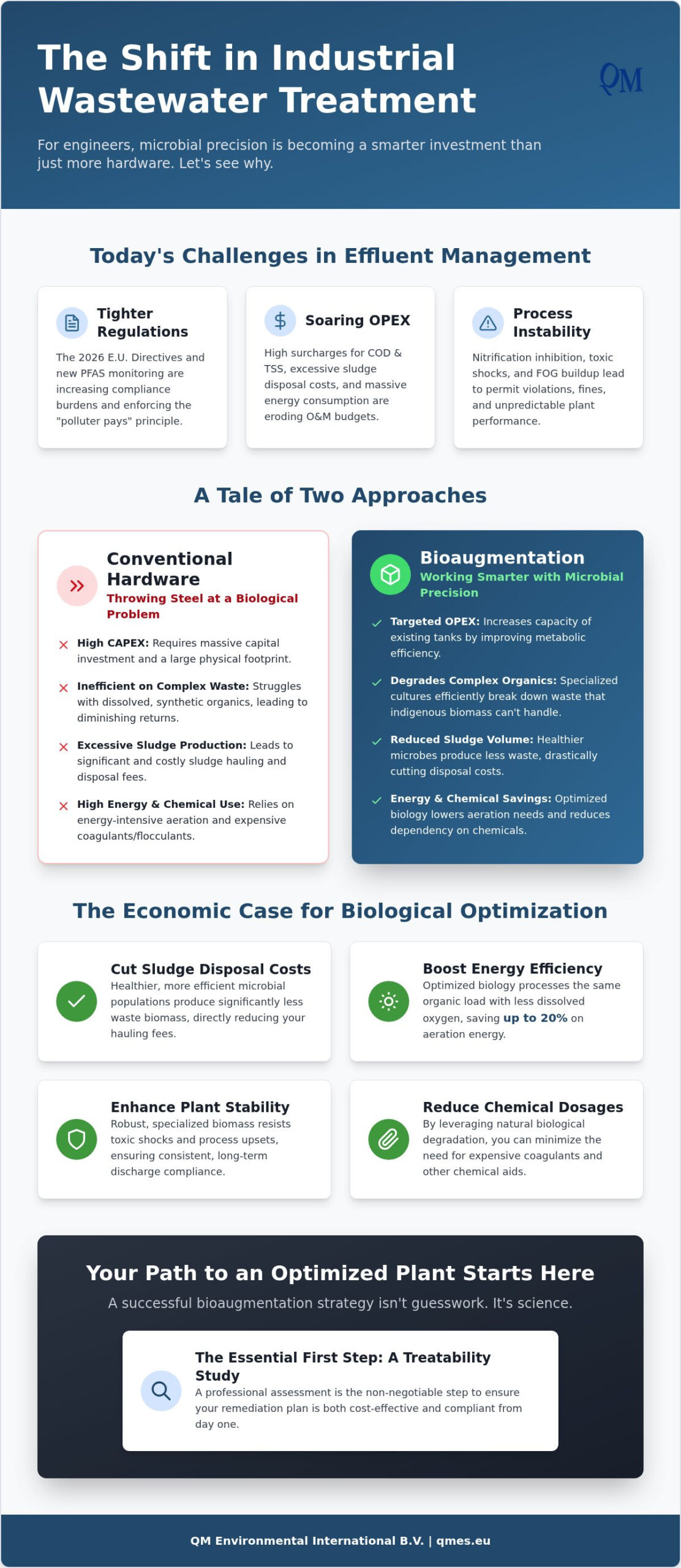
When you look at the numbers, the choice between heavy CAPEX for new hardware and targeted OPEX for biological optimization is often clear. Expanding a plant’s physical footprint is slow and capital-intensive. Conversely, bioaugmentation allows you to increase the capacity of your existing tanks by improving the metabolic rate of the biomass. This approach offers several direct financial benefits:
- Reduced Sludge Volume: Healthier microbial populations produce less waste biomass, significantly cutting your sludge hauling and disposal costs.
- Energy Efficiency: Optimized biology requires less dissolved oxygen to process the same organic load, which can lead to energy savings of up to 20% in aeration systems.
- Chemical Savings: By leveraging natural degradation, you can often reduce the dosage of expensive coagulants and flocculants needed for solids separation.
It’s about working with the biology you have. As we move toward the 2045 goal of energy neutrality in wastewater facilities, the most efficient plants will be those that prioritize microbial health as their primary treatment engine.
Bioaugmentation: The Science of Enhancing Microbial Performance
When you look at a biological reactor, it’s easy to treat it as a "black box" where organics go in and clean water comes out. But as an engineer, you know that the stability of that process depends entirely on the metabolic health of the microbial community. Bioaugmentation is the practice of strategically adding high-performance, specialized microbial cultures to existing systems to enhance their degradative capacity. When evaluating industrial wastewater treatment solutions, many operators overlook the fact that their indigenous "bugs" aren’t always equipped to handle the complex, synthetic organics found in modern manufacturing effluent.
Think of bioaugmentation as a precision tuning tool for your biomass. MicroCat Products are engineered to target complex industrial organics that standard municipal-grade bacteria simply can’t digest efficiently. Performance data from the EPA’s Treatment Technology Database confirms that biological systems remain the backbone of most large-scale facilities, yet they are often the most under-optimized assets on site. By introducing specialized strains, you create a synergistic effect where the added microbes break down complex chains into simpler intermediates that the indigenous population can then finish processing.
This approach is particularly critical for nitrification. Nitrifying bacteria are notoriously sensitive and are often the first to die off during a toxic shock. MicroCat-XNL is specifically formulated to restore nitrification quickly, preventing the spike in ammonia that leads to permit violations. It’s about resilience. Instead of waiting weeks for a system to recover naturally, bioaugmentation provides a shortcut to stability.
Targeted Solutions for Specific Industrial Contaminants
Different industries face vastly different chemical hurdles. In the pulp and paper sector, for instance, managing lignin and cellulose is a primary concern. Pulp and paper wastewater treatment presents unique challenges, as MicroCat products contain specialized strains that excel at breaking down these tough plant fibers, preventing the buildup of recalcitrant COD. For facilities struggling with neighbor complaints, MicroCat-ANL offers a biological path to odor control by aggressively removing H2S and mercaptans at the source. If you’re dealing with hydrocarbon contamination or oily wastes, there are formulations designed to emulsify and degrade these streams before they can foul your equipment or inhibit your biomass. If you’re ready to see how these microbes perform in your specific stream, you can explore our range of advanced biological additives.
Overcoming Inhibition and System Upsets
System upsets aren’t always caused by a single toxic event. Sometimes, it’s a slow decline in performance due to cold weather or the creeping growth of filamentary bacteria. Winter-hardy microbes can be introduced to maintain high metabolic rates even as temperatures drop, preventing the typical seasonal rise in effluent COD. Furthermore, using bioaugmentation as a preventative measure can help maintain a balanced microbial ecology, making it much harder for filaments to dominate and cause bulking issues in your clarifier. It’s a proactive strategy that keeps your plant running within its design parameters regardless of external fluctuations.
Bioaugmentation vs. Conventional Treatment: A Comparative Analysis
When you’re facing a plant that’s reached its design capacity, the traditional engineering response is to start drafting plans for new tankage. But in the context of modern industrial wastewater treatment solutions, building more steel and concrete isn’t always the most efficient path. Conventional treatment relies on the physical size of the reactor to provide enough hydraulic retention time for "standard" microbes to work. Bioaugmentation, however, shifts the focus from volume to density and metabolic rate. By increasing the concentration of specialized microbes, you can often process a higher organic load within your existing footprint, effectively deferring or even eliminating the need for capital-heavy plant expansions.
The difference in startup times is particularly striking. A new biological reactor can take several weeks or even months to develop a mature, stable biomass. If you’re recovering from a toxic shock or starting a seasonal facility, that’s time you don’t have. Bioaugmented systems can reach steady-state performance in a fraction of that time because you’re seeding the system with high-performance cultures rather than waiting for them to grow naturally from the influent. This speed provides a level of operational flexibility that hardware alone can’t match.
Reliability is another major differentiator. Standard biological systems are often fragile; a single spike in influent toxicity can wipe out your nitrifiers and leave you out of compliance for weeks. A bioaugmented approach builds resilience into the system. By regularly supplementing your biomass with products like MicroCat-XNL, you maintain a "reserve" of specialized microbes that can survive fluctuations and recover the process much faster than an unassisted population.
When to Choose Bioaugmentation Over Hardware Upgrades
Before you commit to a major CAPEX project, it’s worth assessing whether your current infrastructure is truly at its biological limit. Bioaugmentation can often handle a significant increase in COD loading without requiring a single new pump or tank. There’s also the question of sludge management. Conventional chemical precipitation using coagulants and flocculants creates a massive volume of chemical sludge that’s expensive to haul and landfill. Switching to a biological focus reduces this volume by degrading organics rather than just binding them into a solid mass. Integrating these additives into your existing DAF or SBR systems is usually a simple matter of setting up a small dosing pump, making it a low-risk, high-reward optimization strategy.
For facilities that package the resulting dried solids or industrial byproducts for transport, utilizing robust machinery and support from Choice Bagging Equipment can help streamline the final stages of the waste management process.
Synergy: Combining Advanced Biology with Modern Hardware
It’s not always an "either-or" scenario. The most effective plants use advanced biology to protect and enhance their modern hardware. For instance, high-performance microbes improve the settling characteristics in secondary clarifiers, leading to clearer effluent and better solids capture. This is especially vital if you’re running sensitive downstream equipment like RO membranes. By reducing biological fouling upstream through better organic removal, you extend the life of your membranes and reduce the frequency of expensive clean-in-place cycles. Even anaerobic digesters benefit from this synergy; using specialized microbial formulations can optimize the breakdown of complex fats and proteins, leading to a measurable increase in biogas yield and better overall energy recovery.
The Path to Implementation: Technical Assessments and Pilot Studies
Success in biological optimization isn’t a matter of luck; it’s the result of rigorous technical validation. Moving from a struggling plant to a stable operation requires a clear understanding of your specific wastewater chemistry. For engineers tasked with overseeing industrial wastewater treatment solutions, the transition from identifying a problem to implementing a biological fix must be grounded in data. This is where Site Assessment and Remediation Planning come into play, ensuring that the chosen microbial strategy aligns with the physical and chemical realities of your facility.
We’ve seen many plants attempt to "dose their way out of trouble" without first understanding why their indigenous biology is failing. Guesswork is expensive. It leads to wasted chemical spend and potential permit violations. A professional Treatability Study is non-negotiable because it provides a roadmap for success before you commit to full-scale implementation. By simulating your plant’s conditions in a controlled environment, we can prove the efficacy of a specific microbial formulation and determine the exact dosage required to meet your discharge limits.
Designing a Professional Treatability Study
A structured study moves through three distinct phases to eliminate technical risk. First, we characterize the influent to identify inhibitory compounds that might be "stunning" your biomass. Second, we select the appropriate MicroCat formulation based on the specific organic profile of your waste stream. Finally, we conduct bench-scale testing to determine the optimal contact time and dosage. This process allows us to monitor key performance indicators (KPIs) like COD reduction rates and ammonia levels under varying conditions, giving you the confidence that the solution will hold up during real-world flow fluctuations.
Site Assessment Protocols for Complex Industrial Sites
Even the best microbes can’t overcome severe mechanical limitations. A comprehensive site assessment evaluates your hydraulic retention time (HRT) and aeration capacity to ensure the biology has the environment it needs to thrive. We look for mechanical bottlenecks, such as poor mixing zones or inadequate clarifier capacity, that might hinder biological performance. This assessment also extends to long-term remediation planning, especially for sites where historical leaks have created ongoing soil and groundwater impacts. For complex contaminated sites, a rigorous in situ bioremediation design framework is essential to ensure that field performance matches your models and that biological systems are engineered to account for the unpredictable realities of subsurface geochemistry. By addressing both the mechanical and biological aspects of the plant, we create a stable environment where the Sludge Volume Index (SVI) remains low and the effluent stays clear.
Don’t leave your compliance to chance. If you’re ready to move from troubleshooting to a stable, optimized process, the first step is a technical evaluation. You can start the process today by requesting a professional Treatability Study to find the right microbial match for your facility.
Advanced Biological Technologies by QM Environmental
While traditional bioaugmentation provides a strong foundation for plant stability, some industrial streams require a more robust delivery mechanism. This is where proprietary advancements in microbial delivery change the equation. When standard "bug-in-a-bag" approaches face extreme toxicity or high washout rates, you need a system that offers both protection and a continuous supply of active biomass. As you evaluate long-term industrial wastewater treatment solutions, it’s worth looking at how encapsulated technology provides a level of resilience that free-swimming microbes simply can’t match.
QM Environmental doesn’t just supply additives; we provide the technical infrastructure to ensure those additives survive. By leveraging Small Bioreactor Platform (SBP) technology, we can introduce specialized microbes into your system within a protective "home." This ensures that even during a toxic shock or a hydraulic surge, your most valuable degraders remain on-site and active. It’s a pragmatic shift from reactive dosing to a steady-state biological engine.
SBP Technology: A Revolution in Bioaugmentation
The Small Bioreactor Platform (SBP) represents a significant leap forward in how we manage complex industrial organics. The core of this technology is the use of encapsulated bacteria. These microbes are housed within a semi-permeable membrane that allows wastewater to enter and be treated while keeping the bacteria safe from predators, toxic inhibitors, and physical washout. This is particularly effective for targeted treatment of difficult compounds like phenols and hydrocarbons that would otherwise stun a conventional biomass.
For the operator, the benefits are practical. SBP units require minimal maintenance and provide a constant, controlled release of high-performance microbes into the main treatment stream. We’ve seen real-world success where combining SBP technology with specialized MicroCat formulations has allowed plants to meet strict 2026 discharge limits without the need for additional clarifiers or expensive chemical pretreatment and where also able to increase their treatment capacity by 20% without major capital investments in new tanks. It’s about maximizing the biological work done in every cubic meter of your existing tankage.
The QM Advantage: Expert-Led Environmental Management
Choosing the right industrial wastewater treatment solutions is as much about the partner as it is about the product. With over 30 years of expertise in environmental biotechnology, we understand that no two waste streams are identical. We don’t believe in a one-size-fits-all approach. Instead, we use our historical data and laboratory capabilities to create customized microbial blends tailored to your unique industrial profile. Whether you’re dealing with the high FOG of food processing or the recalcitrant lignin of a paper mill, we provide the scientific precision needed to stabilize your process. For a deeper look at how these strategies apply to fiber-based industries, our guide on optimizing pulp and paper wastewater treatment covers the specific challenges of managing lignin, AOX, and sludge disposal costs in that sector.
Reliability in wastewater treatment comes from a deep understanding of the "why" behind the process. Our global technical support team works alongside your engineers to monitor KPIs and adjust strategies as your production cycles change. If you’re ready to stop fighting your plant and start optimizing it, the path forward is clear. Contact QM Environmental for a Technical Site Assessment to see how our advanced biological technologies can secure your compliance and lower your operational costs.
Securing Long-Term Plant Stability Through Biological Precision
Optimizing your plant’s performance doesn’t always require a massive capital investment in new hardware. As we’ve explored, the key to handling complex organics and meeting the 2026 regulatory standards lies in the metabolic health of your biomass. By shifting your focus toward microbial precision, you can increase your current system’s capacity, reduce sludge volume, and ensure that nitrification remains stable even during challenging seasonal shifts. It’s a pragmatic approach that prioritizes operational efficiency over simple physical expansion.
Modern industrial wastewater treatment solutions must be as dynamic as the manufacturing processes they support. Whether you’re leveraging proprietary MicroCat formulation technology to target specific contaminants or utilizing proven SBP technology for targeted remediation, the goal is the same: a resilient, compliant, and cost-effective facility. These advanced tools, backed by expert technical site assessments, take the guesswork out of effluent management and put you back in control of your discharge parameters.
The most effective way to validate these results for your specific waste stream is through data-driven testing. We’re ready to help you identify the exact biological match for your facility’s needs. Request a Professional Treatability Study from QM Environmental today to start stabilizing your process and reducing your operational overhead. You don’t have to manage these complex environmental challenges alone; a more efficient and reliable plant is well within reach.
Frequently Asked Questions
What is bioaugmentation in industrial wastewater treatment?
Bioaugmentation is the practice of adding specific, high-performance microbial cultures to an existing system to enhance its degradative capacity. While indigenous bacteria are naturally present, they often lack the specialized metabolic pathways needed to break down complex synthetic organics. By introducing these targeted strains, you’re essentially upgrading your plant’s biological software to handle tougher influent without the need for building new tanks or infrastructure.
How does MicroCat improve wastewater plant performance?
MicroCat products improve performance by providing a specialized blend of microbes that target complex industrial organics that standard biomass can’t process efficiently. It’s particularly effective for stabilizing systems facing fluctuating organic loads or high Chemical Oxygen Demand (COD). By improving the metabolic rate of the biomass, it helps maintain discharge compliance and prevents the "stunned" biomass effect often seen after chemical spills or production spikes.
Can microbial additives reduce biological sludge production?
Yes, microbial additives can significantly reduce sludge production by improving the metabolic efficiency of the degradation process. Healthier, more targeted microbial populations convert more of the organic waste into water and carbon dioxide rather than buildup mass inside the sludge. This reduction in sludge volume directly lowers your operational costs by decreasing the frequency and expense of sludge dewatering, hauling and landfilling at your facility.
What is the difference between SBP technology and traditional bioaugmentation?
The main difference lies in how the microbes are delivered and protected within your system. Traditional bioaugmentation involves dosing free-swimming bacteria directly into the stream, where they’re vulnerable to washout and toxic shocks. SBP technology uses encapsulated bacteria within a protective membrane. This provides a constant supply of active microbes that are shielded from harsh environments, ensuring long-term stability for industrial and municipal wastewater treatment solutions.
How long does it take to see results after implementing a bioaugmentation program?
You’ll typically see measurable improvements in effluent quality within 48 to 72 hours, though full system stabilization usually takes one to two weeks. For acute issues like nitrification recovery, results are often visible within days as the specialized cultures begin to process ammonia. Long-term benefits, such as a lower Sludge Volume Index (SVI) or reduced hauling costs, become more apparent over a full sludge age cycle.
Are microbial products safe for the environment and plant personnel?
Absolutely, these microbial products consist of naturally occurring, non-pathogenic microorganisms that are safe for both the environment and your staff. Unlike harsh chemical coagulants or oxidizers, bioaugmentation relies on biological mechanisms that don’t leave behind toxic residues or create hazardous handling conditions. This makes them a sustainable choice for modern industrial wastewater treatment solutions focused on safety and environmental stewardship.
Maintaining a safe environment also means addressing biological hazards in building structures, such as mould; for expert assistance from ABC Mould Cleaning Solutions, read more.
What is included in a wastewater treatability study?
A treatability study includes a comprehensive characterization of your influent, laboratory-scale testing of various microbial formulations, and the determination of optimal dosage rates. We simulate your plant’s specific conditions to identify potential inhibitors and measure COD or ammonia reduction rates. This data-driven approach ensures that the chosen remediation plan is technically sound and cost-effective before you move to full-scale implementation.
Can bioaugmentation help my plant meet ammonia discharge limits in winter?
Yes, bioaugmentation is highly effective for maintaining nitrification during cold weather when indigenous nitrifiers typically slow down. By introducing winter-hardy microbial strains like MicroCat-XNL, you can maintain high metabolic activity even as wastewater temperatures drop. This proactive strategy prevents ammonia spikes and ensures your plant stays within permit limits throughout the winter months, avoiding the compliance failures that often plague unassisted biological systems. For engineers managing sites with soil and groundwater contamination alongside surface water treatment, understanding the principles of in situ bioremediation design can provide a complementary framework for addressing subsurface contamination sources that may be contributing to your ammonia loading.
Disclaimer
Disclaimer
The information on this site is intended solely for personal, non-commercial use. Reproduction, modification, storage in an automated database, or publication of the contents of this site, or any part of its publications, in any form or for any purpose whatsoever, is prohibited without the written permission of QM Environmental International.
We have compiled the information on this site with the utmost care. However, some information may be outdated or incorrect. QM Environmental International accepts no liability for the consequences of actions or omissions based on the information provided.
We have taken all reasonable steps to keep this site free of computer viruses, but we cannot guarantee that it is completely virus-free. QM Environmental International is not liable for any damage to your computer equipment or software caused by viruses while visiting this site.
This site contains hyperlinks to other websites not designed or managed by QM Environmental International. QM Environmental International accepts no liability for the content and use of these sites.
If you have any questions about our privacy and cookie policy, please contact us at info@qmes.nl.
Last updated: June 24, 2025