
Throwing more aeration at a dairy plant won’t solve a lipid-heavy biomass washout. You’re likely dealing with the daily headache of filamentous bulking, high FOG levels, or the looming 10 mg/L nitrogen discharge limits proposed for 2026. It’s a massive challenge when sludge management can account for as much as half of your total operating costs. We understand that maintaining a stable biological treatment for dairy wastewater feels like a moving target when shock loads hit your system.
This guide explains how specialized microbial additives and SBP technology stabilize your effluent while reducing biological sludge volume. You’ll discover how tools like MicroCat-SXMRF and MicroCat-XNL provide the precision needed to meet strict nutrient limits without massive capital expenditures. We’ll walk through the role of professional treatability studies and site assessments in building a resilient, compliant system that handles whatever the production floor sends your way.
Key Takeaways
- Learn how to manage extreme COD fluctuations and the “FOG factor” that often disrupts oxygen transfer and causes persistent foaming in dairy systems.
- Discover how precision bioaugmentation with MicroCat-SXMRF enhances biological treatment for dairy wastewater by targeting complex organic loads that standard biomass struggles to degrade.
- Understand the specific mechanisms used to reduce biological sludge volume, directly lowering your monthly hauling and dewatering expenses.
- Explore why a site-specific Treatability Study is the critical first step in moving beyond “one-size-fits-all” solutions to achieve long-term effluent stability.
- See how SBP technology acts as a safeguard for specialized microbes, providing improved resilience against the shock loads common in dairy production cycles.
The Unique Challenges of Biological Treatment for Dairy Wastewater
Dairy wastewater is notoriously difficult to manage because it’s not just “dirty water”; it’s a concentrated stream of proteins, sugars, and lipids. If you’re running a treatment plant, you know that production cycles dictate your daily stress levels. One hour the system is stable, and the next, a surge of high-strength whey or a cleaning-in-place (CIP) cycle hits the headworks. This volatility makes biological treatment for dairy wastewater a balancing act that traditional activated sludge systems often fail to maintain without help.
The organic loading is extreme. Chemical Oxygen Demand (COD) and Biochemical Oxygen Demand (BOD) levels can swing by thousands of milligrams per liter in a single shift. Beyond the sheer volume of organics, you have to contend with nutrient imbalances. Dairy effluent often carries high nitrogen and phosphorus ratios that don’t match the “Redfield Ratio” your biomass expects. When you add the antimicrobial effect of caustic CIP chemicals into the mix, it’s easy to see why biomass health is constantly under siege. These chemicals don’t just shift pH; they can actively lyse the cell walls of your hard-earned bacteria, leading to a total system crash.
The Impact of High Lipid Concentrations
Fats, oils, and grease (FOG) represent one of the most significant technical hurdles in agricultural wastewater treatment for the dairy sector. Lipids are hydrophobic and require specialized extracellular enzymes, like lipases, to break down into fatty acids before they can be consumed. Without these enzymes, FOG coats the microbial flocs, creating a physical barrier that inhibits oxygen transfer. This leads to several operational failures:
- Filamentous Bulking: Certain bacteria thrive on long-chain fatty acids, leading to sludge that won’t settle in the secondary clarifier.
- Foaming: Trapped air in grease-coated biomass creates stable foam that can overflow tanks and create safety hazards.
- Anaerobic Inhibition: In digesters, untreated grease can form “scum blankets” that prevent gas release and reduce effective treatment volume.
Managing Fluctuating pH and Temperature
Rapid acidification is a constant threat. When lactose and whey enter the system, indigenous bacteria ferment them into volatile fatty acids (VFAs) almost immediately. This drops the pH, which can inhibit the very microbes you need for BOD removal. Temperature adds another layer of complexity. High-temperature wash-downs during sanitation cycles can spike the influent temperature, literally “cooking” the biomass if the equalization tank isn’t sized correctly. Maintaining biological treatment for dairy wastewater during these operational shifts requires more than just aeration. It requires a biomass that’s specifically reinforced to handle these dairy-related stressors through targeted bioaugmentation.
Advanced Bioaugmentation Mechanisms for Dairy Waste Degradation
Bioaugmentation is the strategic introduction of high-performance microbial cultures to supplement your existing biomass. It’s not about replacing your native bacteria but giving them a specialized workforce. While your indigenous microbes handle general BOD, they often struggle with the complex lipid profiles found in dairy effluent. By integrating precision additives into your biological treatment for dairy wastewater, you provide the system with the tools needed to degrade high-strength organics that would otherwise cause a washout.
Interestingly, the science of utilizing specific microbial strains to optimize a biological environment extends to human health as well; for those interested in the gut-brain connection, you can learn more about Love Biotica and how specialized probiotics support mental clarity.
MicroCat-SXMRF serves as a resilient backbone for these systems. It’s formulated to thrive under the high COD loads that typically overwhelm standard activated sludge. These microbes produce extracellular enzymes that liquefy complex solids, turning difficult fats into simpler molecules. This mechanism is supported by a scientific review of dairy wastewater treatment, which notes that biological pathways are essential for managing the high-strength streams found in the dairy sector.
Targeting Fats, Oils, and Grease with MicroCat
MicroCat-AL is specifically engineered to break through the “FOG barrier.” It produces high concentrations of lipases that liquefy lipid accumulations before they can coat flocs or trigger filamentous bulking. This helps prevent grease-related odors and keeps pipes clear of heavy blockages. Regular dosing with MicroCat-AL has been shown to reduce the frequency of grease trap cleaning by keeping lipids in a liquid, degradable state. If you’re struggling with persistent grease issues, a site assessment and remediation plan can help pinpoint the optimal dosing points to maximize efficiency.
Nitrification and Nitrogen Removal
With nitrogen discharge limits tightening toward 10 mg/L in many regions by 2026, ammonia removal is a priority. Nitrifying bacteria are notoriously fragile. They’re often the first to fail during a CIP chemical shock or a sudden temperature drop. MicroCat-XNL provides a concentrated source of nitrifiers to restore ammonia removal capacity quickly. This ensures your biological treatment for dairy wastewater remains compliant even during cold weather or after a significant system upset.
Bioaugmentation vs. Traditional Secondary Treatment
When your plant hits its capacity limit, the standard engineering response is often to look at capital-intensive expansions or a shift toward Membrane Bioreactor (MBR) technology. While MBRs offer high efficiency, their operating costs can be double those of traditional fixed-bed systems. Bioaugmentation offers a pragmatic alternative. It allows you to squeeze significantly more performance out of your existing biological treatment for dairy wastewater without the multi-million dollar price tag of new concrete and steel. By optimizing the microbial community, you can manage higher organic loads within your current tank volume.
The most immediate operational impact is seen in sludge management. Industry data indicates that sludge handling can account for as much as half of the total cost of a biological treatment system. Traditional secondary treatment often produces a high volume of biological solids that require expensive dewatering and hauling. Bioaugmentation reduces this yield by ensuring more complete mineralization of organic matter. When microbes are more efficient at breaking down dairy solids, more COD is converted to CO2 and less ends up as waste biomass. This directly lowers your spending on polymers and disposal fees. For a broader perspective on how microbial precision outperforms mechanical expansion across sectors, the technical overview of industrial wastewater treatment solutions explains why biological optimization consistently delivers better returns than adding more hardware.
Scientific evidence supports this shift in strategy. Research into Bioaugmentative Approaches for Dairy Wastewater shows that using acclimated and immobilized biomass improves the metabolic pathways needed to handle complex dairy streams. This specialized approach ensures that the energy used for aeration actually results in contaminant removal rather than just sustaining a struggling, native population. The same bioaugmentation principles that stabilize dairy systems have proven equally effective in other high-strength industrial streams; operators managing pulp and paper wastewater treatment face similar challenges with toxic shocks, COD spikes, and sludge disposal costs that bioaugmentation strategies can address.
Controlling Sludge Bulking and Foaming
Filamentous bacteria are a common plague in dairy plants, thriving in the high-VFA environments created by fermented lactose. These organisms create a “bridging” effect between flocs that prevents settling, leading to a high Sludge Volume Index (SVI). Instead of relying on aggressive chlorination, which can kill off your beneficial nitrifiers, you can use MicroCat-ANL. This additive works by outcompeting nuisance filaments for available nutrients. It restores the balance of the microbial population, favoring the growth of dense, heavy flocs that settle rapidly in the clarifier.
SBP Technology: Encapsulated Biomass Protection
SBP technology represents a significant leap forward in biomass management. By encapsulating specialized microbial cultures within a protective macro-capsule, we can maintain an extremely high microbial density that’s immune to hydraulic washouts. It’s an ideal solution for plants that experience frequent “slug” loads or hydraulic surges. These capsules protect sensitive nitrifiers from the toxic shocks of CIP chemicals, ensuring that your biological treatment for dairy wastewater stays consistent and compliant even when production goes into a high-intensity cleaning cycle.
The Role of Treatability Studies in Plant Optimization
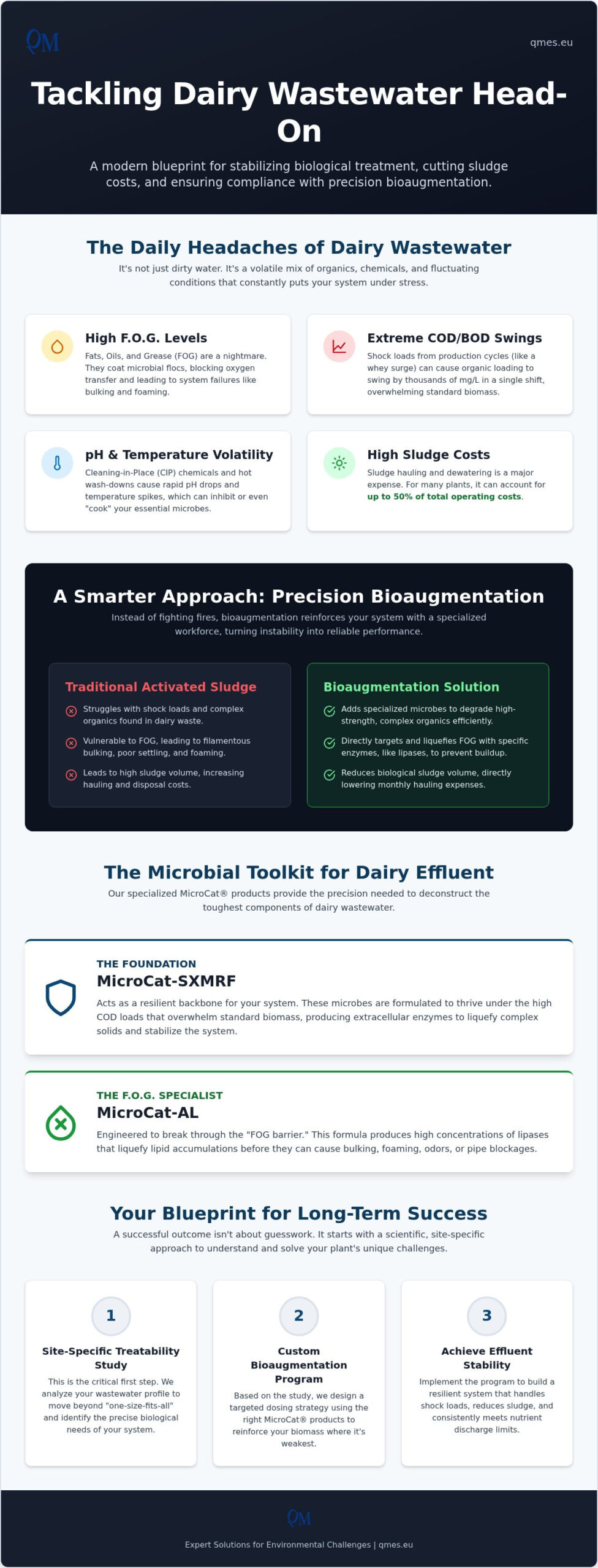
You wouldn’t design a structural beam without first calculating the load. The same logic applies to the biological treatment for dairy wastewater. A generic, “one-size-fits-all” microbial blend often fails because the chemical fingerprint of a cheese facility is vastly different from a milk bottling plant. One might have high concentrations of chlorides from brine, while the other is struggling with high-temperature wash-downs. Treatability Studies bridge the gap between lab-scale theories and the messy reality of a full-scale plant floor.
Treatability Studies allow us to move beyond guesswork. We analyze your specific wastewater chemistry to determine which microbial strains will actually thrive in your tanks. This data-driven approach ensures that the bioaugmentation strategy we design is tailored to your unique organic loading rates and hydraulic retention times. It’s the only way to guarantee a predictable ROI before you commit to a full-scale implementation.
Analyzing Wastewater Microbiology
We start by diagnosing the health of your existing activated sludge. Using microscopic analysis, we look for specific bio-indicators that signal system stress. Are the flocs small and pin-like? Is there an overgrowth of Nocardia causing stable foam? By correlating these microbial populations with your current plant performance metrics, we can identify inhibition factors before they cause a compliance failure. This microscopic “early warning system” helps us select the right MicroCat products to stabilize the biomass.
Pilot Studies and Performance Prediction
This phase is where we simulate your plant conditions to verify microbial efficacy. We use bench-scale reactors to test how our targeted cultures handle your specific influent. During this process, we set realistic KPIs for your facility, such as:
- Percentage reduction in Chemical Oxygen Demand (COD)
- Specific targets for biological sludge volume reduction
- Restoration of nitrification rates under cold-weather simulations
- Reduction in polymer consumption for dewatering
These pilot results allow us to design a dosing protocol that minimizes operational labor while maximizing effluent quality.
Success depends on looking at the entire wastewater circuit, not just the aeration tank. Our Site Assessment and Remediation Planning services provide a holistic view, ensuring that equalization, pH control, and nutrient dosing are all optimized to support the new microbial community. If you want to move from reactive troubleshooting to proactive management, the first step is to schedule a Treatability Study for your facility.
Implementing a Biological Solution with QM Environmental
Integrating specialized microbial cultures like MicroCat-SXMRF into your existing plant doesn’t require a total redesign. It’s a surgical intervention. We focus on augmenting your existing activated sludge with strains that are pre-acclimated to high-load industrial organics. This transition ensures your biological treatment for dairy wastewater remains stable even when production peaks or your influent chemistry shifts unexpectedly. By focusing on the biological mechanisms first, we help you avoid the massive capital costs of tank expansions or expensive membrane upgrades.
One of our most effective tools for high-risk zones is SBP technology. While many competitors overlook the power of encapsulated bacteria, we’ve found it’s essential for dairy plants that face frequent hydraulic surges or chemical shocks. These macro-capsules act as a protected reservoir for your most sensitive nitrifiers and lipid-degrading microbes. If a toxic shock load hits the headworks, the encapsulated biomass survives within its protective shell. This allows the system to recover its treatment capacity in hours rather than the weeks it might take for a native population to regrow naturally.
Next Steps for Dairy Plant Operators
To get started, we recommend a Site Assessment and Remediation Planning session. You’ll need to gather some baseline data to help us understand your specific challenges. We typically look at average and peak flow rates, historical COD and BOD profiles, and a list of your current CIP chemicals. This information helps us design a precise Treatability Study to identify the right microbial blend for your facility. During the first 30 days of implementation, you’ll see a distinct shift. We start with an initial “seed” dose to establish the microbial population, followed by a lower maintenance dose to ensure long-term stability and continued sludge reduction.
The QM Environmental Advantage
With over 30 years of expertise, QM Environmental has built a reputation as a reliable partner for complex industrial challenges. We combine a global reach with localized technical support, ensuring you have science-backed solutions that work on the ground. Our focus is on pragmatic innovation that provides a stable, compliant biological treatment for dairy wastewater while reducing your total operational costs. We don’t just sell products; we provide the technical oversight needed to ensure your system meets the stricter environmental standards of 2026 and beyond, a goal that also encompasses the responsible management of electronic waste through partners like 億鑫鴻景電子 (Yixin Hongjing Electronics).
Future-Proofing Your Dairy Effluent Strategy
Managing a dairy plant’s wastewater doesn’t have to be a constant cycle of troubleshooting and sludge hauling. By shifting your focus toward precision bioaugmentation, you can stabilize your biological treatment for dairy wastewater and handle those difficult FOG and COD surges with confidence. We’ve seen how targeted microbial additives and SBP technology provide the resilience needed to meet tightening nitrogen limits without the need for expensive plant expansions.
Success isn’t about guessing; it’s about data. With over 25 years of experience in environmental biotechnology, QM Environmental provides the specialized expertise and global technical support required for complex, site-specific remediation. Whether you’re struggling with filamentous bulking or looking to reduce your biological sludge volume, our team is ready to help you optimize your system for long-term reliability.
The path to a more efficient, compliant facility starts with a clear understanding of your specific wastewater chemistry. Request a Professional Treatability Study for Your Dairy Facility today to discover exactly how our proprietary SBP technology can protect your plant’s performance. It’s time to take control of your effluent quality and build a more sustainable future for your operations.
Frequently Asked Questions
What is the primary benefit of bioaugmentation in dairy wastewater treatment?
The primary benefit is the stabilization of effluent quality against the extreme organic fluctuations common in dairy production. By introducing specialized microbes, the system becomes more resilient to shock loads and high FOG levels. This proactive approach ensures a consistent biological treatment for dairy wastewater, preventing the biomass washouts that lead to compliance failures. It’s about moving from reactive troubleshooting to a steady, predictable process that protects your discharge permits.
How does MicroCat-SXMRF differ from standard wastewater additives?
MicroCat-SXMRF is engineered specifically for high-load industrial environments rather than generic municipal waste. Unlike standard additives that may contain broad-spectrum bacteria, SXMRF features microbial strains pre-acclimated to degrade complex proteins and lipids. These microbes produce the specific extracellular enzymes required to liquefy dairy solids, ensuring that the biomass remains active and efficient even when Chemical Oxygen Demand (COD) levels spike during peak production cycles.
Can biological treatment handle high levels of cleaning chemicals (CIP)?
Yes, biological systems can handle CIP chemicals if they’re properly reinforced with bioaugmentation. While caustic cleaners can lyse standard bacteria, certain specialized strains in the MicroCat range exhibit much higher tolerance to pH shifts and surfactants. Additionally, leveraging SBP technology provides a physical barrier that protects the core microbial population from toxic shock, allowing the system to maintain nitrification and BOD removal during intense cleaning cycles.
How long does it take to see results after starting a MicroCat program?
You’ll typically see measurable improvements in plant performance within 14 to 30 days of starting a MicroCat program. The initial seeding phase establishes the specialized microbial population within your existing biomass. During this first month, operators usually notice better sludge settleability, a reduction in surface foaming, and more stable COD removal rates. The exact timeline depends on your system’s hydraulic retention time and the specific organic loading challenges.
What is SBP technology and how does it protect the treatment system?
SBP technology is a proprietary macro-encapsulation system that houses specialized microbes within protective capsules. These capsules act as a “safe haven,” preventing the microbes from being washed out during hydraulic surges or killed by sudden chemical spikes. By maintaining a high density of protected biomass, SBP technology ensures that your biological treatment for dairy wastewater recovers almost immediately after a system upset, providing a level of stability that unshielded bacteria can’t match.
Is a Treatability Study necessary before using microbial products?
We strongly recommend a Treatability Study to ensure the success of any bioaugmentation program. Every dairy facility has a unique chemical fingerprint based on its product mix and cleaning protocols. A study allows us to simulate your specific plant conditions in a lab setting, identifying the exact microbial blend and dosing requirements needed for your influent. This data-driven approach eliminates the risk of using a “one-size-fits-all” solution that might fail under real-world stress.
How does bioaugmentation help in reducing sludge disposal costs?
Bioaugmentation reduces sludge costs by increasing the metabolic efficiency of the biomass, which results in lower yield coefficients. When specialized microbes like MicroCat-SXMRF are present, they convert a higher percentage of organic contaminants into carbon dioxide and water rather than new cellular mass. This leads to a measurable reduction in biological sludge volume, directly lowering the expenses associated with polymer usage, dewatering, and off-site hauling and disposal.
Can these biological solutions help with odor control in dairy lagoons?
Yes, bioaugmentation is highly effective for controlling odors in dairy lagoons and storage ponds. Odors are usually caused by the anaerobic breakdown of proteins and sulfur compounds into volatile organic acids and hydrogen sulfide. Specialized products like MicroCat-ANL or MicroCat-SH accelerate the complete degradation of these compounds, eliminating the smell at its source. This approach is much more effective than masking agents because it addresses the underlying biological imbalance.
Disclaimer
Disclaimer
The information on this site is intended solely for personal, non-commercial use. Reproduction, modification, storage in an automated database, or publication of the contents of this site, or any part of its publications, in any form or for any purpose whatsoever, is prohibited without the written permission of QM Environmental International.
We have compiled the information on this site with the utmost care. However, some information may be outdated or incorrect. QM Environmental International accepts no liability for the consequences of actions or omissions based on the information provided.
We have taken all reasonable steps to keep this site free of computer viruses, but we cannot guarantee that it is completely virus-free. QM Environmental International is not liable for any damage to your computer equipment or software caused by viruses while visiting this site.
This site contains hyperlinks to other websites not designed or managed by QM Environmental International. QM Environmental International accepts no liability for the content and use of these sites.
If you have any questions about our privacy and cookie policy, please contact us at info@qmes.nl.
Last updated: June 24, 2025